ACE CEO Insights | By Dr. Moddie Rachid
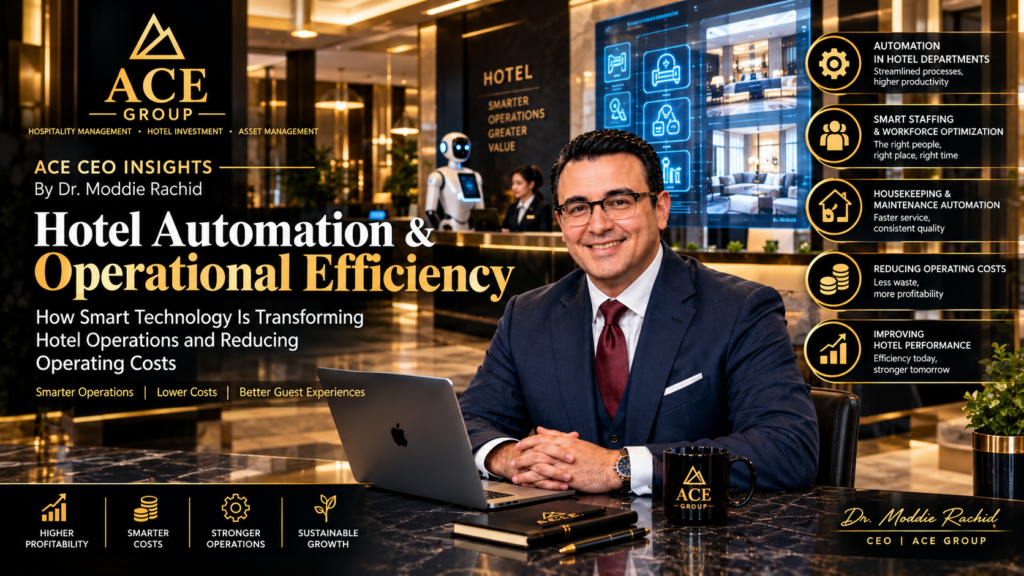
How Smart Technology Is Transforming Hotel Operations and Reducing Operating Costs
Building Smarter Operations Without Losing the Human Touch
Introduction
The future of hotel operations is not simply about using more technology. It is about creating smarter, faster, and more efficient operations while maintaining the human connection that defines exceptional hospitality.
Hotel automation is changing the way properties manage their daily activities, control operating costs, improve productivity, and deliver guest experiences.
However, successful automation is not about replacing people with machines. It is about empowering hotel teams to focus on what matters most: service quality, operational performance, and guest satisfaction.
1. Automation Starts with Operational Strategy
Before introducing new technology, hotel management must identify operational challenges and understand where automation can create measurable value.
Common opportunities include:
– Front office and guest check-in procedures.- Housekeeping scheduling and room
-status updates.
– Engineering maintenance requests.
– Inventory and purchasing controls.
– Financial reporting and operational monitoring.
– Guest communication and service requests.
The objective is to eliminate unnecessary manual work, reduce delays, and improve coordination between departments.Technology should support a clear operational strategy, not become an expense without measurable results.
2. Improving Front Office Efficiency
The front office is one of the most important areas where automation can improve productivity.
Digital check-in, mobile guest communication, automated payment processing, and integrated Property Management Systems can reduce administrative workloads and waiting times.
This allows front office teams to spend less time on repetitive transactions and more time welcoming guests, resolving problems, and creating positive first impressions.
The real benefit is not simply faster check-in. It is a better balance between operational efficiency and personalized service.
3. Smarter Housekeeping Operations
Housekeeping productivity has a direct impact on room availability, labor costs, and guest satisfaction.
Automated room-status updates and digital task-management systems allow housekeeping supervisors to assign rooms, monitor cleaning progress, and communicate with the front office in real time.
This improves room turnaround time, reduces communication errors, and helps management allocate manpower according to actual occupancy levels.
A well-managed housekeeping operation does not necessarily require more employees. It requires better planning, coordination, and productivity.
4. Engineering and Preventive Maintenance
Unexpected equipment failures can create significant operating expenses and negatively affect the guest experience.
Modern maintenance-management systems help engineering teams schedule preventive maintenance, monitor equipment performance, and track maintenance requests.
By moving from reactive maintenance to preventive planning, hotels can reduce unnecessary breakdowns, protect assets, and improve the useful life of equipment.For hotel owners, this is not just an engineering improvement. It is an asset-protection strategy.
5. Automation in Financial and Cost Control
One of the strongest advantages of hotel automation is its ability to improve financial visibility.
Integrated systems can help management monitor:
– Daily revenue and departmental performance.
– Labor productivity and payroll expenses.
– Food and beverage inventory.
– Purchasing and stock movements.
– Operating expenses against budget.- Departmental profitability.
When information is accurate and available on time, General Managers and department heads can identify problems earlier and make better decisions.
Automation should ultimately contribute to stronger financial discipline and improved profitability.
6. The Human Factor: Technology Cannot Replace Hospitality
There is an important distinction between automating hotel operations and automating the hospitality experience.
Guests may appreciate digital convenience, but they still value genuine attention, personal recognition, and professional service.Technology should remove operational obstacles so employees can dedicate more time to guests.
The strongest hotels will be those that combine intelligent systems with well-trained, motivated, and empowered employees.
7. Measuring the Results
Hotel management should never evaluate automation based on the number of systems installed.
The real measurement must be operational and financial performance.
Key indicators include:
– Labor cost as a percentage of revenue.- Revenue per available room (RevPAR).
– Gross Operating Profit (GOP).
– Room turnaround time.
– Maintenance costs.
– Guest satisfaction scores.
– Employee productivity.
Every automation investment should have clear objectives, measurable results, and a realistic return-on-investment assessment.
8. The General Manager’s Responsibility
The General Manager plays a central role in successful automation.
Technology decisions must be connected to the hotel’s business plan, operational requirements, financial objectives, and service standards.
A successful GM must ensure that department heads understand how to use these systems, that employees receive proper training, and that technology investments deliver tangible improvements.Buying technology is easy.
Integrating it into daily hotel operations and achieving measurable results is the real management challenge.
Conclusion:
Smarter Operations, Stronger HotelsHotel automation is no longer simply a technological advantage. It is becoming an important component of modern hotel management.
However, technology alone does not create a successful hotel.Success comes from combining efficient systems, disciplined management, productive employees, financial control, and exceptional guest service.
As I have always believed, the objective of hotel management is not merely to operate a property, but to maximize its performance, protect its long-term value, and create sustainable profitability.
The hotels that will lead the future are not necessarily those with the most technology, but those that know how to use technology intelligently.
Dr. Moddie Rachid
Group CEO | Hospitality Consultant | Hotel General Manager | Hotel Turnaround & Asset Growth Specialist
ACE Group USA | ACE Group Hotel
Hospitality Management • Hotel Investment • Asset Management
Sharing practical hospitality knowledge to help hotel owners, investors, and leaders build stronger businesses and lasting value.
Read More Articles;
https://acegroupusa.com/category/ace-ceo-insights/