
ACE CEO Insights | By Dr. Moddie Rachid
Introduction
In today’s competitive hospitality industry, successful hotel management depends not only on experience and leadership, but also on the ability to understand information and make timely, informed decisions.Modern hotels generate enormous amounts of operational and financial data every day. However, collecting data is not enough.
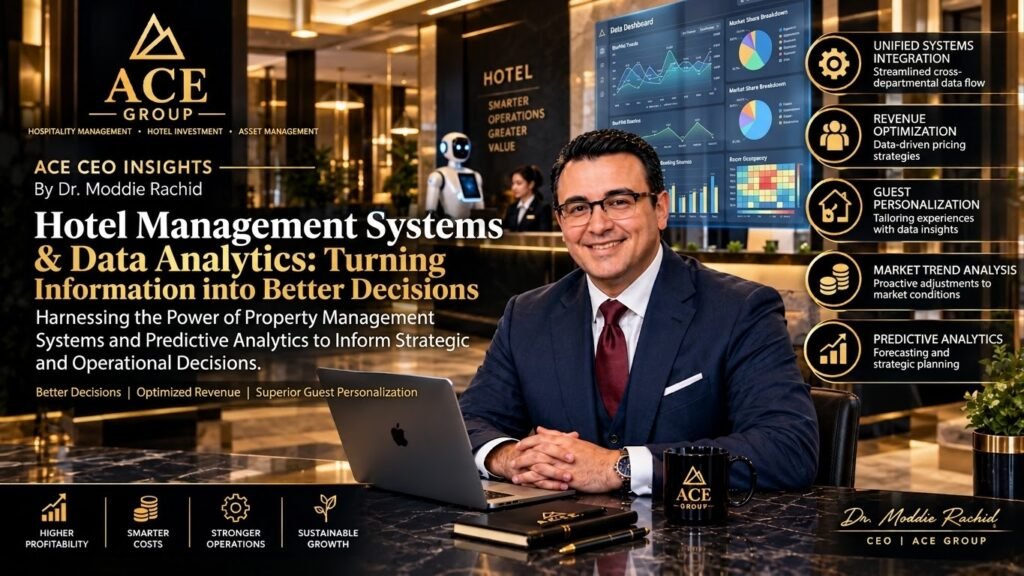
The real value comes from understanding what the numbers reveal and using that information to improve performance.Hotel Management Systems (HMS) and Data Analytics have become essential management tools, helping General Managers control operations, maximize revenue, reduce unnecessary costs, and protect long-term asset value.
1. The Importance of Integrated Hotel Management Systems
A modern hotel operates through multiple interconnected departments, including Front Office, Housekeeping, Food & Beverage, Finance, Sales, Engineering, and Human Resources.
An integrated management system connects these departments and provides management with a clearer picture of the hotel’s overall performance.
A well-integrated technology environment can help management monitor:
– Room availability and occupancy.- Reservations and revenue performance.
– Guest profiles and preferences.- Departmental expenses.
– Housekeeping and maintenance activities.- Purchasing and inventory movements.
When information is properly connected, management can reduce communication gaps, improve coordination, and respond faster to operational challenges.
2. Data Analytics: Understanding What the Numbers Really Mean
Hotel performance should never be evaluated through assumptions alone.Data analytics helps management identify patterns, understand business trends, and recognize operational weaknesses before they become serious problems.
For example, declining occupancy may not necessarily indicate weak demand. It could be related to pricing strategy, distribution channels, market positioning, or changes in the competitive environment.
The responsibility of management is to understand the reasons behind the numbers, not simply report them.
3. Revenue Management and Better Forecasting
One of the strongest applications of hotel data analytics is revenue management.By analyzing historical performance, booking patterns, market demand, competitor positioning, and seasonal trends, hotels can make more informed pricing and inventory decisions.
Key performance indicators include:
– Occupancy Rate.- Average Daily Rate (ADR).- Revenue per Available Room (RevPAR).
– Total Revenue per Available Room (TRevPAR).
– Revenue forecasts and booking pace.The objective is not simply to sell more rooms.
It is to achieve the right balance between occupancy, pricing, and total profitability.
4. Financial Control and Departmental Performance
A successful General Manager must understand the financial performance of every major department.Integrated reporting and analytics allow management to compare actual results against budgets, identify unexpected expenses, and monitor departmental profitability.
For example, increasing restaurant revenue does not automatically mean improved profitability if food costs, labor expenses, and wastage are also increasing.
Data-driven financial control helps management identify these gaps and take corrective action.
5. Predictive Analytics: Moving from Reaction to Prevention
Modern analytics can help hotels anticipate future operational requirements.Historical occupancy patterns and reservation data can support workforce planning, purchasing forecasts, and inventory management.
Predictive maintenance can also help engineering teams identify potential equipment problems before they result in expensive breakdowns.This approach allows hotels to move away from reactive management toward more proactive and controlled operations.
6. The General Manager: Turning Data into Action
Technology provides information, but leadership determines how that information is used.
A General Manager should not depend entirely on automated reports or dashboards.
The numbers must be interpreted through operational experience, market knowledge, financial understanding, and direct communication with department heads.
The most effective management approach combines three essential elements:
– Accurate and timely information.
– Professional management judgment.
– Clear accountability and follow-up.
A dashboard is valuable only when it leads to better decisions and measurable improvements.
7. Measuring the Real Return on Technology
Investing in hotel management systems and analytical tools requires financial discipline.Before introducing new technology, owners and management teams should evaluate its expected benefits, implementation costs, training requirements, and long-term return on investment.
The results should be measured through improved productivity, stronger revenue performance, better cost control, fewer operational errors, and increased profitability.
Technology must serve the hotel’s business objectives, not become another unnecessary operating expense.
Conclusion:
Better Information Creates Better ManagementThe future of hotel management belongs to organizations that understand how to transform information into action.Hotel Management Systems and Data Analytics are no longer simply technical tools.
They are important instruments for operational control, financial performance, and strategic decision-making.In my experience, a successful General Manager must understand both the human side of hospitality and the financial story behind the numbers.
Data tells us what is happening. Experience helps us understand why. Leadership determines what happens next.That is how information becomes performance, and performance becomes long-term hotel value.
Dr. Moddie Rachid
Group CEO | Hotel General Manager | Hospitality ConsultantHotel Turnaround & Asset Growth Specialist
ACE Group USA | ACE Group Hotel
Hospitality Management • Hotel Investment • Asset Management

Read More Articles;
https://acegroupusa.com/category/ace-ceo-insights/
Sharing practical hospitality knowledge to help hotel owners, investors, and leaders build stronger businesses and lasting value.