
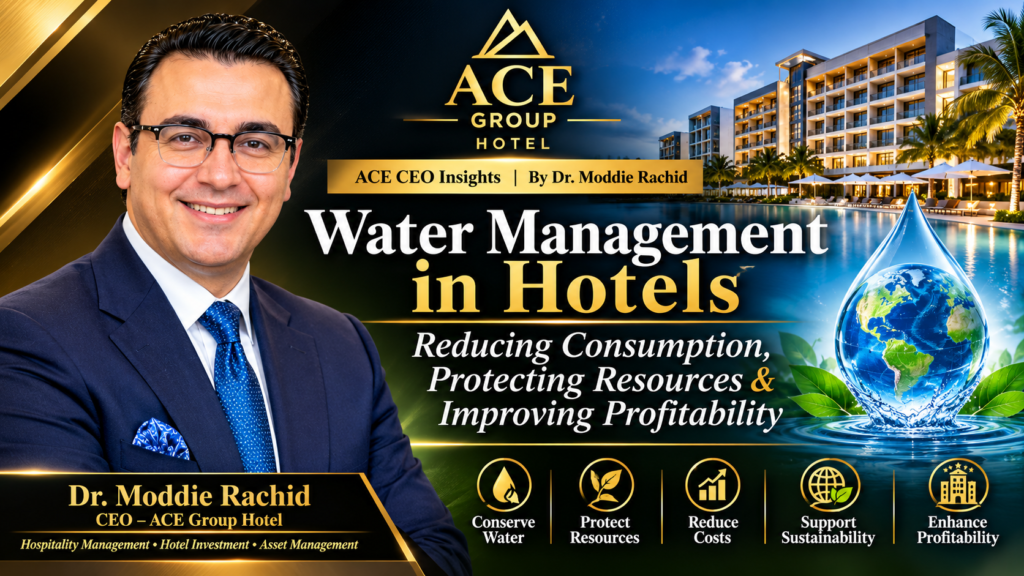
ACE CEO Insights | By Dr. Moddie Rachid
Introduction:
Water Is a Strategic Business Resource
Water is one of the most essential resources in hotel operations. From guest rooms and kitchens to laundry facilities, swimming pools, landscaping, and housekeeping, almost every hotel department depends on a reliable water supply.
However, water consumption is not simply an operational necessity. It is also a significant cost factor and an increasingly important sustainability responsibility.
For hotel owners and operators, effective water management creates an opportunity to achieve three objectives simultaneously:
reduce operating expenses, protect natural resources, and maintain the quality of the guest experience.
The most successful hotels do not approach water conservation as an isolated environmental initiative.
They integrate it into operational planning, financial management, engineering performance, and long-term asset strategy.
1. Understanding Where Hotels Consume Water
Before implementing a water-saving strategy, hotel management must understand where water is being consumed.
The main consumption areas typically include:
– Guest Rooms: Showers, bathtubs, washbasins, toilets, and housekeeping activities.
– Laundry Operations: Washing machines, linen processing, and laundry equipment.
– Kitchens & Restaurants: Food preparation, dishwashing, cleaning, and sanitation.
– Swimming Pools & Spas: Pool replenishment, filtration, backwashing, and spa facilities.
– Landscaping: Irrigation systems, gardens, lawns, and outdoor spaces.
– Engineering & Maintenance: Cooling systems, equipment cleaning, and general technical operations.
Understanding these consumption patterns allows management to identify inefficiencies and prioritize investments where they can generate the greatest operational and financial benefits.
2. Smart Water Monitoring and Leak Detection
One of the most important steps toward effective water management is establishing accurate measurement and monitoring systems.
Many hotels experience unnecessary water losses because leaks, excessive consumption, and equipment inefficiencies are not identified quickly enough.
Management should implement:
– Sub-metering for major consumption areas.
– Regular inspection of water distribution networks.
– Smart meters and automated monitoring systems.- Early leak-detection technologies.
– Daily and monthly consumption reports.
– Preventive maintenance programs.
Engineering teams should monitor unusual consumption patterns and investigate unexpected increases immediately.
A hotel cannot effectively manage what it does not measure.
3. Guest Room Water Efficiency Without Compromising Comfort
Guest satisfaction must remain a priority when introducing water-saving measures.Water efficiency should never create an uncomfortable experience or reduce the perceived quality of hotel services.
Practical improvements include:
– Installing high-efficiency showerheads.
– Using water-efficient faucets and aerators.
– Introducing dual-flush or low-consumption toilets.
– Maintaining plumbing systems to prevent leaks.
– Using efficient bathroom fixtures during renovations.
– Offering responsible linen and towel-reuse programs.
The objective is not to ask guests to sacrifice comfort. It is to deliver the same level of service while using resources more intelligently.
4. Optimizing Laundry and Housekeeping Operations
Laundry is an important area of water consumption, particularly in large hotels, resorts, and properties with extensive linen requirements.
Improving laundry efficiency can reduce water consumption while also lowering energy, detergent, and maintenance costs.
Recommended strategies include:
– Investing in high-efficiency commercial washing machines.
– Matching washing cycles to actual laundry requirements.
– Avoiding unnecessary partial loads.
– Implementing appropriate linen-reuse programs.
– Monitoring water consumption per kilogram of laundry.
– Maintaining washing equipment regularly.
Housekeeping departments should also receive practical training in responsible cleaning procedures and water-efficient practices.
Operational discipline is essential.
Technology alone cannot deliver sustainable results without consistent management and employee engagement.
5. Swimming Pools, Landscaping and Outdoor Water ManagementResorts and destination hotels often face additional challenges because of swimming pools, extensive gardens, golf facilities, and outdoor recreational areas.These facilities can create substantial water demand, particularly in hot climates and seasonal destinations.
Hotels can improve efficiency through:
Swimming Pools- Regular monitoring of evaporation and water losses.
– Efficient filtration and backwashing procedures.- Proper pool maintenance.
– Appropriate pool covers where operationally suitable.
Landscaping- Selecting plants suitable for the local climate.
– Installing drip irrigation systems.
– Using irrigation schedules based on actual soil and weather conditions.
– Applying smart irrigation controllers.
– Reducing unnecessary watering during cooler periods.
Landscape design should be considered part of the hotel’s sustainability strategy, not simply an aesthetic decision.6. Wastewater Treatment and Water Recycling
Forward-looking hotel operators increasingly evaluate opportunities to reuse water where regulations, infrastructure, and operational conditions permit.
Treated wastewater and greywater can potentially support selected non-potable applications, such as:
– Landscape irrigation.
– Toilet flushing.
– Certain cleaning applications.
– Other approved technical uses.However, water reuse requires appropriate treatment systems, monitoring, maintenance, and compliance with local health and environmental regulations.
Hotels must ensure that recycled water is never used in applications that could compromise guest health or safety.
For large resorts and properties with significant outdoor water requirements, properly designed recycling systems can become an important long-term investment.
7. The Financial Impact of Water Management
Water conservation is not only an environmental responsibility.
It is also a financial management opportunity.
Reducing water consumption can produce savings across several operating areas:
– Lower water purchasing and utility expenses.
– Reduced wastewater and sewage costs.
– Lower energy consumption associated with water heating.
– Reduced detergent and laundry operating costs.
– Fewer maintenance problems caused by leaks and inefficient equipment.
Hotel management should evaluate every major water-efficiency investment through a financial framework.
Key performance indicators should include:
– Water consumption per occupied room.
– Water consumption per guest night.
– Water cost as a percentage of total operating expenses.
– Laundry water consumption per kilogram of linen.
– Water consumption per available room.
– Estimated savings generated by efficiency projects.
The financial evaluation should consider initial investment, annual savings, maintenance expenses, equipment lifespan, and expected payback period.
The objective is to identify projects that deliver measurable operational improvements and sustainable financial returns.
8. Building a Hotel-Wide Water Management Culture
Successful water management cannot be achieved by the engineering department alone.It requires cooperation across all hotel departments.
The General Manager should establish clear accountability, supported by the Director of Engineering, Executive Housekeeper, Executive Chef, Laundry Manager, Finance Department, and Sustainability team.An effective program should include:
1. Establishing a reliable water-consumption baseline.
2. Setting measurable reduction targets.
3. Assigning responsibility to each department.
4. Training employees on water-efficient practices.
5. Monitoring performance through monthly reports.
6. Reviewing results and implementing corrective actions.
Guest communication should also be professional and informative, encouraging responsible resource use without creating an impression that the hotel is reducing service standards.
9. The Role of Leadership in Sustainable Water Management
Water efficiency is ultimately a management decision.
The General Manager must ensure that sustainability objectives are translated into practical operational standards and measurable financial results.
Hotel owners and asset managers should also recognize that water efficiency can contribute to long-term asset protection, operating-cost control, and stronger environmental performance.
In markets where water availability is limited, responsible water management may also support business continuity and reduce exposure to operational risks.
The strongest hospitality organizations understand that environmental responsibility and commercial performance are not competing priorities.
When managed correctly, they reinforce each other.
Conclusion:
Protecting Resources While Strengthening Profitability
Water management should be treated as a core component of modern hotel management.
By combining accurate monitoring, efficient equipment, employee engagement, responsible operating procedures, and appropriate water-reuse technologies, hotels can reduce unnecessary consumption without compromising guest satisfaction.
For hotel owners, investors, and operators, the opportunity is clear: protect valuable resources, improve operational efficiency, strengthen financial performance, and create more sustainable hospitality assets.
The future of successful hotel management will depend not only on how effectively hotels serve their guests, but also on how responsibly they manage the resources that make that service possible.
Dr. Moddie Rachid
CEO – ACE Group HotelHospitality Management • Hotel Investment • Asset Management
Read More Articles;
https://acegroupusa.com/category/ace-ceo-insights/
Sharing practical hospitality knowledge to help hotel owners, investors, and leaders build stronger businesses and lasting value.