
ACE CEO Insights | By Dr. Moddie Rachid
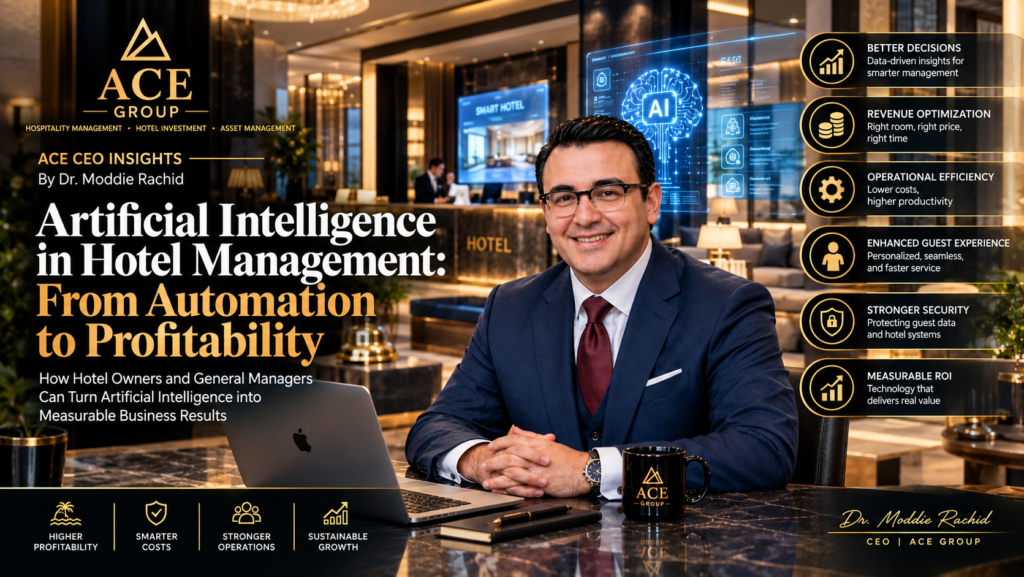
How Hotel Owners and General Managers Can Turn Artificial Intelligence into Measurable Business Results
Introduction: Technology Must Create Business Value
Artificial intelligence is changing the hospitality industry. From forecasting demand and optimizing room rates to improving guest communication and supporting operational decisions, AI is creating new opportunities for hotels to operate more efficiently and compete more effectively.
However, adopting technology does not automatically make a hotel more profitable.
The real question for hotel owners, investors, and general managers is not how much technology a property can introduce, but how effectively that technology improves revenue, controls costs, strengthens guest satisfaction, and protects long-term asset value.
AI should support better hospitality decisions—not replace hospitality leadership.
1. AI and the General Manager’s Decision-Making Process
A General Manager must continuously balance guest satisfaction, employee performance, operating expenses, revenue targets, and owner expectations.
AI can help by analyzing large volumes of operational and financial data, identifying patterns, and highlighting potential problems before they become serious.
For example, an AI-supported reporting system may identify rising labor costs, declining restaurant profitability, unusual maintenance expenses, or changes in booking patterns.Instead of spending hours collecting information from multiple departments, the General Manager can focus on interpreting the findings, questioning assumptions, and deciding what action to take.
The objective is not to remove managerial judgment. It is to give management better information, faster.
2. Revenue Optimization: Selling the Right Room at the Right Price
Hotel revenue depends on more than occupancy. Room rates, distribution costs, booking patterns, seasonality, and the profitability of different customer segments all influence financial performance.
AI can support revenue management by analyzing historical performance, current reservations, booking pace, market demand, and other relevant data.
These insights can help revenue teams:
– Forecast demand more accurately.
– Identify opportunities to adjust room rates.
– Recognize periods when promotional offers may be necessary.
– Evaluate booking channels and customer segments.- Reduce the risk of selling rooms below their potential value.
Nevertheless, automated pricing must be monitored. Poor data, unexpected events, or an incorrect understanding of local market conditions can produce misleading recommendations.
The Revenue Manager and General Manager remain accountable for the final strategy.
3. Improving Operational Efficiency and Cost Control
Labor, energy, food, maintenance, and supplies are major components of hotel operating expenses.
AI can help management identify inefficiencies and allocate resources more intelligently.In housekeeping, demand forecasts and room-status information can improve daily workload planning. In engineering, predictive maintenance tools may identify equipment patterns that indicate a developing fault. In food and beverage operations, demand forecasting can help purchasing teams plan quantities and reduce avoidable waste.These applications can deliver benefits when they are connected to reliable operational data and supported by effective departmental procedures.
However, reducing costs should never become an excuse for understaffing, declining cleanliness standards, or weakening service quality.
The goal is to eliminate waste, not eliminate the standards that make guests return.
4. Enhancing the Guest Experience Without Losing the Human Touch
Hospitality is fundamentally a people business. Guests may appreciate faster responses, personalized recommendations, convenient digital services, and fewer delays, but they also value empathy, recognition, and genuine human interaction.
AI-powered tools can assist with routine inquiries, multilingual communication, guest preference analysis, and personalized offers. They can also help teams identify recurring complaints and improve service recovery.Yet technology has limitations.
A guest experiencing a serious complaint, a family facing an unexpected problem, or a VIP requiring special attention may need direct human support.
Hotels should therefore design AI around the guest journey, ensuring that digital convenience complements personal service rather than becoming a barrier to it.Privacy, transparency, and appropriate handling of guest information must remain essential parts of the process.
5. Measuring the Financial Return on AI Investment
One of the most important responsibilities of hotel leadership is determining whether a technology investment produces measurable value.
Before introducing an AI solution, management should establish a clear business case and identify the performance indicators that will determine success.
Relevant measures may include:
– Incremental room revenue and contribution margin.
– Labor productivity and overtime costs.- Food waste and purchasing efficiency.
– Maintenance downtime and repair expenses.- Guest satisfaction and complaint-resolution times.
– Total technology costs, including integration, training, and ongoing support.
For example, if an AI application reduces operating expenses, management must compare the actual savings against licensing fees, implementation costs, staff training, and additional oversight.
Similarly, an increase in revenue should not automatically be attributed to AI without considering market growth, pricing changes, seasonality, and other contributing factors.The objective is to measure the improvement that the technology genuinely delivers.
6. Managing the Risks of Artificial Intelligence
AI introduces risks that hotel leaders must address before expanding its use.Poor-quality data can lead to inaccurate forecasts. Excessive reliance on automated recommendations can weaken managerial oversight.
Improper handling of personal information can damage guest trust, while cybersecurity weaknesses may expose sensitive systems and records.
Hotels should establish clear policies covering data access, privacy, human approval, vendor accountability, and the appropriate use of AI-generated recommendations.Employees also need training.
Technology creates value only when the people using it understand its purpose, limitations, and relationship to their responsibilities.
A successful implementation therefore requires cooperation among hotel operations, finance, information technology, human resources, and executive management.
7. A Practical Implementation Strategy for Hotel Owners
Hotels do not need to transform every department simultaneously. A disciplined, phased approach is generally more practical.
Step 1: Identify a genuine business problem. Select an area where performance can be measured, such as demand forecasting, energy consumption, or maintenance planning.
Step 2: Establish a baseline. Record current costs, service standards, productivity, and financial performance before implementation.
Step 3: Run a controlled pilot. Test the solution in a defined department or process and compare the results with the baseline.
Step 4: Train employees and establish controls. Define responsibilities, escalation procedures, privacy safeguards, and human oversight.
Step 5: Evaluate the results. Confirm whether the solution improves measurable business outcomes without compromising guest experience.
Step 6: Expand selectively. Scale successful applications and discontinue or redesign solutions that fail to deliver sufficient value.
This approach helps protect the hotel’s capital, reduces implementation risk, and encourages decisions based on evidence rather than enthusiasm for new technology.
Conclusion:
AI Must Serve the Hotel’s StrategyArtificial intelligence is becoming an important management tool across the hospitality industry.
Its greatest value, however, will not come from the number of digital systems a hotel installs.It will come from the quality of the decisions those systems help management make.For hotel owners, the priority is a credible business case and a measurable return on investment. For General Managers, it is better control, stronger decision-making, and consistent operating standards.
For employees, it is technology that supports their work rather than creating unnecessary complexity.
For guests, it is a more convenient, responsive, and personalized experience.
The hotels that benefit most will be those that combine reliable data, capable leadership, trained employees, and disciplined financial management.
Technology may improve the way a hotel operates, but leadership determines whether those improvements create lasting value.—
Dr. Moddie Rachid
Hospitality Consultant | Hotel General Manager | Hotel Turnaround & Asset Growth Specialist
CEO, ACE Group USA
ACE Group USA — Hospitality Management • Hotel Investment • Asset Management
Beyond Hotel Operations. Building Profitable Hospitality Assets.

Read more articles;
https://acegroupusa.com/category/ace-ceo-insights/
Sharing practical hospitality knowledge to help hotel owners, investors, and leaders build stronger businesses and lasting value.