
ACE CEO Insights | By Dr. Moddie Rachid
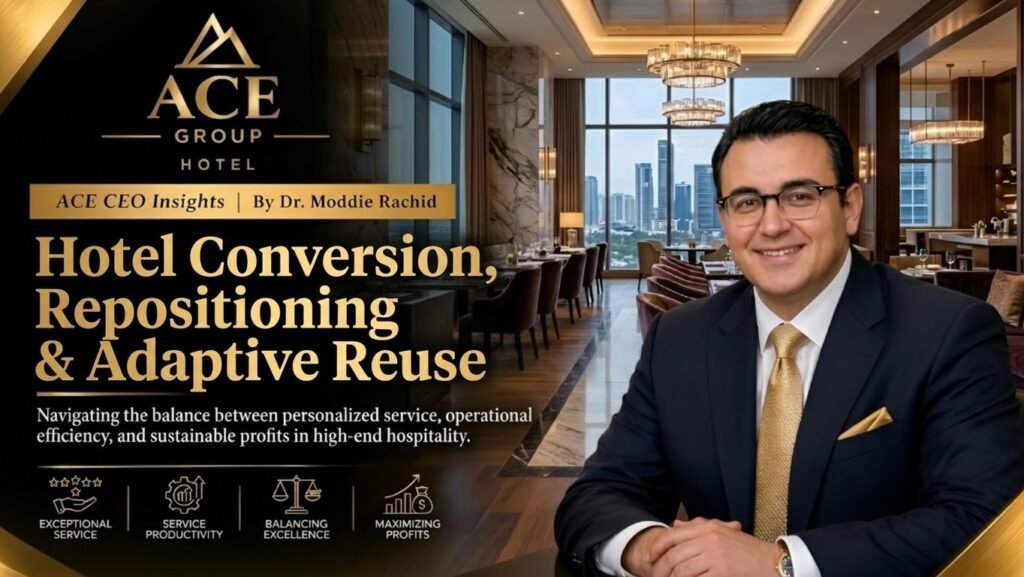
Transforming Existing Properties into Profitable Hotel Investments
Introduction:
Seeing Opportunity Where Others See LimitationsIn hospitality investment, the next successful hotel does not always need to be built from the ground up.
Sometimes, the greatest opportunity lies in an existing property that has lost its competitive position, an outdated hotel that no longer meets market expectations, or a building that can be transformed into a distinctive hospitality asset.
Hotel conversion, repositioning, and adaptive reuse offer investors opportunities to create value while potentially reducing development time and making better use of existing assets. However, success depends on much more than renovating rooms or introducing a new brand. It requires a clear investment strategy, realistic financial projections, and a business model aligned with market demand.
1. Understanding the Three Investment Strategies
Hotel Conversion involves transforming an existing building or property into a hotel, or changing a property’s operating concept to serve a different hospitality segment.
Hotel Repositioning focuses on changing a hotel’s market identity, target audience, service standards, pricing strategy, or brand positioning to improve its competitive performance.
Adaptive Reuse involves giving an existing building a new purpose, such as transforming a historic property, office building, or former institutional facility into a hotel, subject to applicable regulations and technical feasibility.
Although these strategies differ, they share one objective: unlocking the hidden value of an existing asset.
2. Start with the Market, Not the Building
One of the most common investment mistakes is falling in love with a property before understanding its market potential.Before committing capital, investors must evaluate demand generators, competitive supply, average daily rate (ADR), occupancy patterns, seasonality, customer segments, and the property’s accessibility.
A building may have impressive architecture and an attractive purchase price, yet remain commercially unsuitable for hospitality.The essential question is not whether the property can become a hotel. It is whether the market can support a profitable hotel at the required investment level.
3. Build a Realistic Financial Model
A conversion project must be evaluated using its total investment cost, not simply the purchase price and visible renovation expenses.
The financial assessment should include:- Acquisition costs and financing expenses.
– Structural repairs and building-system upgrades.
– Fire safety, accessibility, and regulatory compliance.
– Guestroom and public-area renovation.- Furniture, fixtures, equipment, and technology.
– Pre-opening expenses, recruitment, training, and marketing.
– Contingency reserves and working capital.
Investors should then model expected revenue, departmental expenses, payroll, operating costs, management fees, and capital replacement requirements.
Key performance indicators include ADR, RevPAR, occupancy, Gross Operating Profit (GOP), Net Operating Income (NOI), and return on invested capital.
A project that appears attractive before renovation can become financially unviable once hidden costs and realistic operating expenses are included.
4. Choose the Right Positioning and Brand
Not every existing property should be transformed into a luxury hotel.Depending on location and demand, the stronger opportunity may be a boutique hotel, an extended-stay property, an upscale lifestyle concept, a business hotel, or a resort-oriented product.
The positioning must match the building’s physical limitations, customer demand, competitive landscape, and achievable room rates.
Brand selection also matters. Investors must determine whether an established hotel brand can generate sufficient additional revenue and distribution benefits to justify its fees and operating requirements, or whether an independent concept offers a better financial outcome.
5. The General Manager’s Role in Value Creation
A successful conversion begins long before the first guest arrives.The General Manager should participate in the planning process to ensure that the proposed design supports efficient operations, appropriate staffing, guest experience, service standards, and long-term profitability.
Operational considerations include room layouts, housekeeping productivity, kitchen capacity, engineering access, storage, back-of-house circulation, energy efficiency, and technology integration.
A visually impressive hotel can still underperform if its design creates unnecessary labor costs or operational bottlenecks.
The GM must connect the owner’s investment objectives with the practical realities of daily hotel operations.
6. Control Execution Risk
Conversion and adaptive reuse projects can involve substantial uncertainty. Older buildings may contain structural deficiencies, outdated mechanical systems, hazardous materials, or limitations that are not apparent during an initial inspection.
Before construction begins, investors should commission appropriate technical surveys, validate regulatory requirements, establish a detailed project budget, and create a realistic schedule.
Changes in scope, construction delays, and cost overruns can erode the projected return on investment.Strong project governance, clear accountability, regular cost reporting, and coordination between the owner, consultants, contractors, operator, and brand are essential.
7. Measure Success Beyond Renovation
A completed renovation is not proof of a successful investment.The real test begins when the hotel opens or relaunches. Management must track performance against the approved business plan, monitor guest feedback, manage distribution costs, control payroll, and adjust pricing according to demand.
Investors should establish measurable performance targets and review actual results against forecasts throughout the first operating year.
The objective is not simply to create a more attractive property. It is to build a sustainable hospitality business that generates reliable operating income and strengthens the underlying asset’s long-term value.
Conclusion:
Create Value with Strategy, Not Just Capital
Hotel conversion, repositioning, and adaptive reuse can create compelling opportunities for hospitality investors, but they require disciplined decision-making.
The strongest projects begin with market demand, proceed through rigorous feasibility analysis, incorporate operational expertise from the earliest planning stages, and maintain financial control throughout execution.
As a hospitality executive, I believe the true value of a hotel investment is not determined by what we spend to transform a property, but by how intelligently we position, operate, and sustain that asset over time.A building provides the opportunity.
The strategy creates the business. And disciplined management determines whether the investment delivers lasting value.
Dr. Moddie Rachid
Hospitality Executive | Hotel General Manager Hotel Investment & Asset Management Specialist
ACE Group USA | ACE Group Hotel
Sharing practical hospitality knowledge to help hotel owners, investors, and leaders build stronger businesses and lasting value.
Read more articles;
https://acegroupusa.com/category/ace-ceo-insights/