
ACE CEO Insights | By Dr. Moddie Rachid
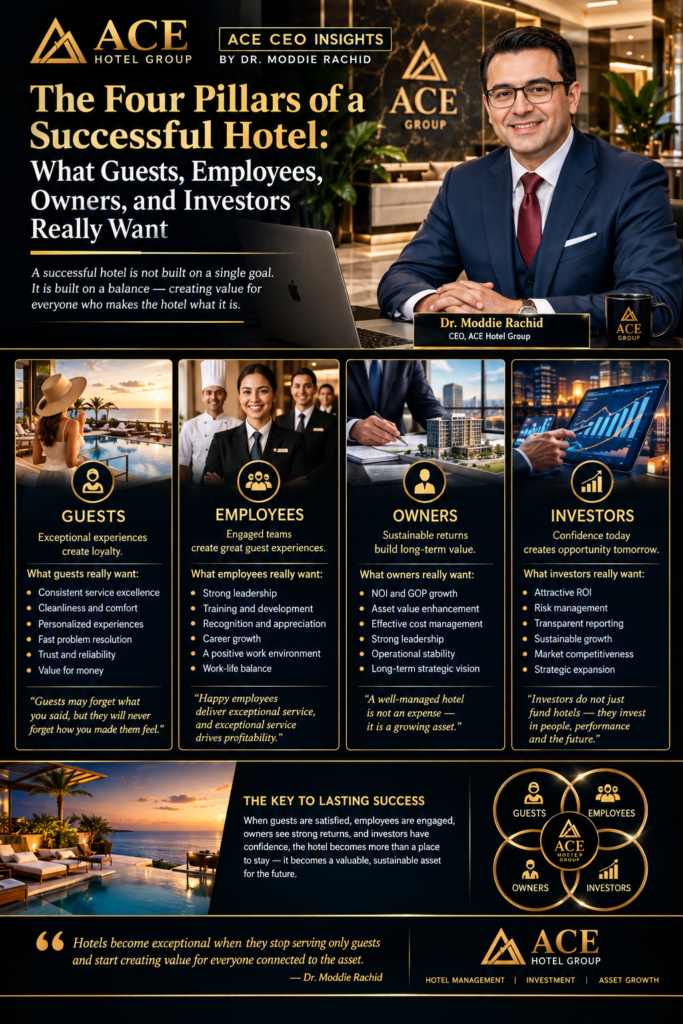
A successful hotel is not measured by occupancy alone, revenue alone, or even guest satisfaction alone.A truly successful hotel must satisfy four different stakeholders at the same time: Guests, Employees, Owners, and Investors.
Each group has different expectations. Yet the success of one directly affects the success of the others.When these four pillars are aligned, the hotel becomes more than a place that sells rooms and services. It becomes a strong hospitality business, a healthy workplace, a profitable operation, and a valuable long-term asset.
1. Guests — They Want More Than a Room
The guest is at the center of every hotel business.But what guests want is not simply a clean room and a comfortable bed. They want to feel that the hotel understands what they expect and delivers it consistently.
What really matters to guests?
Service:
Guests remember how they were treated. Professional, warm, and responsive service creates an emotional connection with the hotel.
Cleanliness:
Cleanliness is not an option. It is one of the fundamental reasons guests trust a hotel.
Consistency:
A guest who receives excellent service today expects the same standard tomorrow. Successful hotels create reliable experiences rather than occasional moments of excellence.
Problem Resolution:
Every hotel will eventually face complaints or service failures. The difference is how quickly and professionally the hotel responds.
Personalized Experience:
Guests increasingly value recognition and personalization. Remembering preferences, anticipating needs, and making guests feel valued can turn a first-time visitor into a repeat guest.
Trust:
A successful hotel delivers what it promises. The gap between the promise and the actual experience is often where guest loyalty is lost.Ultimately, guests want to leave the hotel saying:
I would stay here again
That simple sentence is one of the strongest indicators of hospitality success.
2. Employees — They Want to Be Valued, Respected, and Developed
A hotel cannot consistently deliver an excellent guest experience if its employees are disengaged.Employees are the people who transform a hotel’s strategy into the guest’s actual experience.From the front desk to housekeeping, engineering, food and beverage, finance, sales, and every other department, employees directly influence the hotel’s reputation and performance.
What do employees really want?
Respect:
People perform better when they feel respected by their leaders and colleagues.Clear
Expectations:
Employees need to understand what is expected from them and how their performance is measured.
Training and Development:
Hospitality is a people business. Investing in employee development creates stronger teams and better service.
Recognition:
Employees want their contribution to be noticed. Recognition does not always have to be financial. Appreciation, responsibility, career opportunities, and professional respect matter as well.
Fair Leadership:
Employees quickly recognize inconsistent or unfair management. Strong hotels build cultures based on accountability, fairness, and professionalism.
A Sense of Belonging:
People perform differently when they feel they are part of something rather than simply working for a paycheck.When employees are engaged, the guest experience improves.And when the guest experience improves, the hotel’s commercial performance can improve as well.
3. Owners — They Want Profitability and Long-Term Value
Hotel owners have a different perspective.They are not only looking at whether guests are happy. They are looking at whether the hotel is generating the financial results required to justify the investment.Owners want the hotel to operate efficiently, generate cash flow, protect margins, and increase the value of the asset over time.
What do owners really want?
Profitability:
Revenue is important, but revenue without healthy margins does not create a successful hotel business.
Strong GOP and NOI:
Owners need management to understand the difference between generating revenue and generating profit.
Cost Control:
Cost management is not simply about cutting expenses. It is about understanding where money is being spent and whether that spending creates value.
Cash Flow:
A profitable-looking operation can still experience cash-flow pressure. Strong financial management requires close attention to working capital, expenses, purchasing, payroll, and cash generation.
Asset Protection:
A hotel is a long-term investment. Poor maintenance, weak standards, declining service, or short-term decisions can damage the asset.
Strategic Growth:
Owners want management to think beyond today’s results and protect the hotel’s future performance.The owner’s question is ultimately:“Is my hotel becoming a stronger and more valuable asset?”
4. Investors — They Want Confidence, Returns, and Sustainable Growth
Investors look at the hotel from an even broader perspective.They are interested not only in today’s operating performance but also in the hotel’s ability to generate sustainable returns in the future.An investor wants confidence that the hotel has a clear strategy, capable management, controlled risks, and realistic growth opportunities.
What do investors really want?
Return on Investment:The investment must have the potential to produce appropriate financial returns.
Risk Management:
Hotels operate in a changing environment. Market conditions, competition, labor costs, inflation, demand patterns, and operational risks can all affect performance.
Sustainable Growth:
Investors are interested in growth that can be maintained, not temporary performance created through unsustainable decisions.Strong Strategy:A hotel needs a clear understanding of its market position, customer segments, competitive environment, and long-term direction.
Transparency:
Investors need accurate information and clear reporting to understand how the asset is performing.
Confidence in Management:
Investors need to believe that the hotel is being managed with discipline, accountability, and a long-term perspective.The investor’s question is:“Can this hotel continue creating value in the future?”
The Four Pillars Must Work Together
The most important lesson is that these four pillars are not independent.They are connected.Guests → Employees → Owners → InvestorsAnd the relationship works in both directions.When employees are engaged, they are more likely to deliver better service.Better service can create stronger guest satisfaction and loyalty.Stronger guest loyalty can support revenue and market performance.Better financial performance can create stronger returns for owners.Strong asset performance can increase investor confidence.And when owners and investors invest properly in people, facilities, training, technology, and the guest experience, the entire hotel can become stronger.This creates a cycle of sustainable performance.
What Happens When One Pillar Is Ignored?
A hotel can look successful while one of these pillars is quietly becoming weaker.
If guests are ignored:
The hotel may lose loyalty, reputation, and future demand.
If employees are ignored:
Service quality can decline, turnover can increase, and operational consistency can suffer.
If owners are ignored:
The hotel may generate revenue but fail to produce the financial results required from the asset.
If investors are ignored:
Short-term operational decisions may replace long-term value creation.The strongest hotels understand that success cannot be built by satisfying only one stakeholder.
The Real Definition of a Successful Hotel
A successful hotel is not simply the hotel with the highest occupancy.It is not necessarily the hotel with the highest ADR.It is not the hotel with the biggest team.And it is not simply the hotel generating the highest revenue.A truly successful hotel is one where:Guests want to return.Employees want to stay and grow.Owners see strong operational and financial performance.Investors see sustainable long-term value.When these four outcomes exist together, the hotel has something much more powerful than short-term success.It has a sustainable business model.
Final Thoughts
Hospitality is ultimately a business of balance.The guest needs an experience worth returning for.The employee needs an environment worth contributing to.The owner needs a business capable of generating profit and protecting the asset.And the investor needs confidence that the asset can continue creating value over time.The responsibility of hotel leadership is to understand all four perspectives and connect them into one operating strategy.Because the best hotels do not choose between guests, employees, owners, and investors.They build a system where all four can succeed together.That is what sustainable hospitality leadership looks like.
About Dr. Moddie Rachid
Dr. Moddie Rachid is a hospitality executive, hotel General Manager, CEO, and hospitality consultant with extensive international experience in hotel operations, management, investment, asset growth, and hotel performance.
Through ACE Group Hotel / ACE Group USA, he focuses on helping hotel owners and investors improve operational performance, profitability, guest experience, and long-term asset value.
ACE Group USA
Hospitality Management • Hotel Investment • Asset Management
Leadership is not about titles — it’s about building a vision that creates lasting impact.
Honored to represent ACE Group with a commitment to innovation, strategic growth, and shaping the future of business.
History tells us where we came from. Leadership determines what we leave behind.
Read more articles:
https://acegroupusa.com/ceo-insights/
The best hotels do not choose between guests, employees, owners, and investors. They create value for everyone connected to the asset.
Dr. Moddie Rachid