
ACE CEO Insights | By Dr. Moddie Rachid
Opening an 800-room luxury hotel is one of the most complex challenges in hospitality.Unlike an operating hotel with years of historical data, a pre-opening property offers no previous budgets, no established performance benchmarks, no operating trends, and no historical revenue patterns. Every decision made before opening can influence profitability, guest satisfaction, operational efficiency, and long-term asset value for years to come.
The question is simple:
How can a General Manager build a realistic budget for a hotel that has never operated before?
The answer requires leadership, market intelligence, financial discipline, and strategic planning.
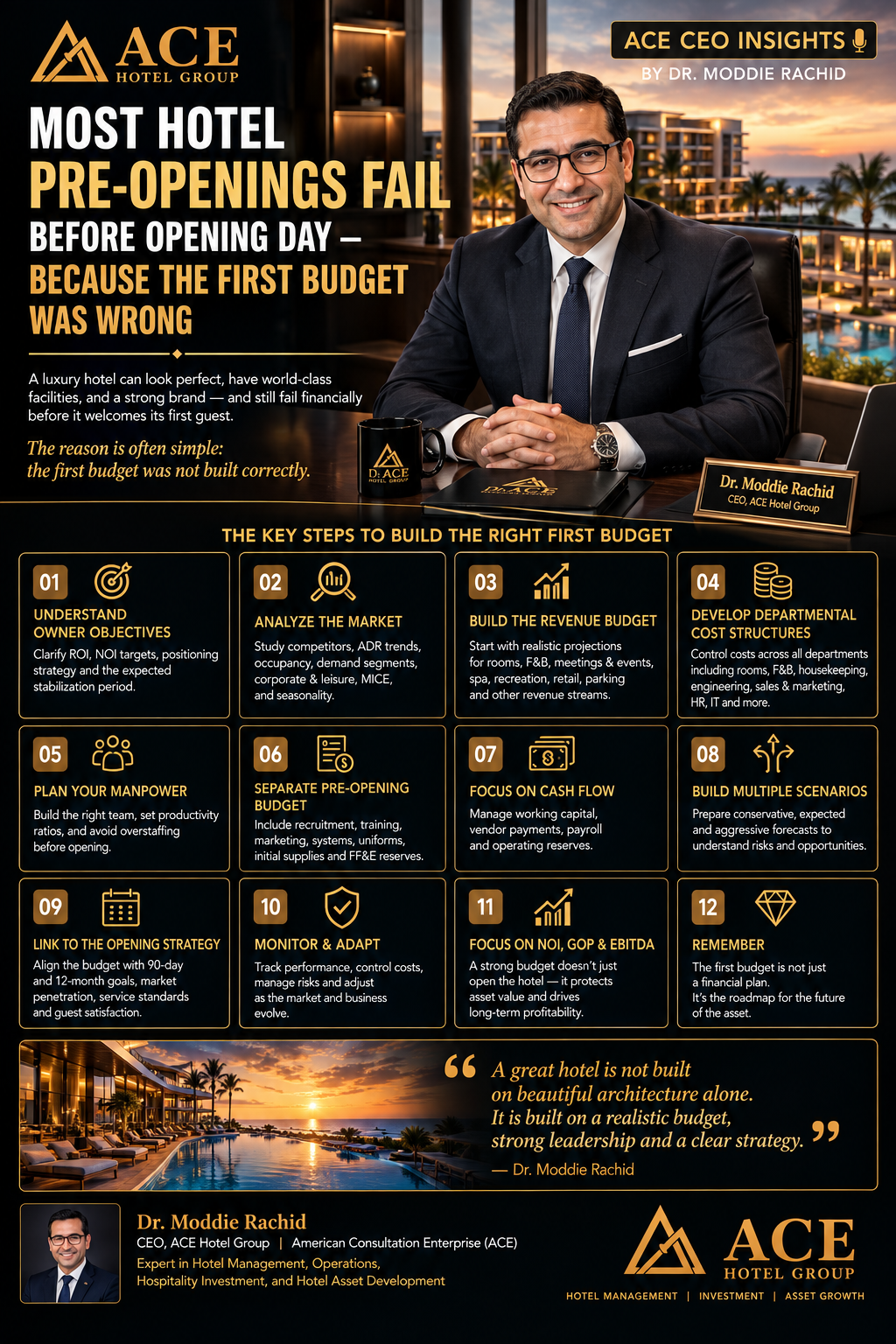
Step 1: Understand the Owner’s Investment Objectives
Before building a budget, the General Manager must fully understand the owner’s expectations.Key questions include:- What is the expected return on investment?- What is the target NOI?- What positioning strategy will be adopted?- Is the focus on market share, profitability, or brand recognition?- What is the expected stabilization period?Without clear ownership objectives, budgeting becomes guesswork.
Step 2: Conduct a Detailed Market Feasibility Analysis
A pre-opening budget cannot be based on assumptions.The General Manager must analyze:- Competitive hotels- ADR trends- Occupancy levels- Market segmentation- Corporate demand- Leisure demand- Group and MICE potential- Seasonality patternsThe market—not the owner’s ambition—should determine the revenue forecast.
Step 3: Build the Revenue Budget First
One of the biggest mistakes during pre-opening is starting with expenses.Revenue drives everything.The budget should begin with:Rooms Division- Number of available rooms- Forecast occupancy- Average Daily Rate (ADR)- RevPAR projections
Food & Beverage- Restaurants- Bars- Banquets- Room service- Specialty outletsMeetings & Events- Conference facilities- Weddings- Corporate events- Social eventsOther Revenue Streams- Spa- Recreation- Retail- Parking- Laundry- Resort fees
Every department budget should be built around realistic revenue assumptions.
Step 4: Establish Departmental Cost Structures
Without historical data, benchmark ratios become critical.The General Manager should develop preliminary budgets for:Rooms Division- Payroll- Guest supplies- Uniforms- Laundry- Amenities
Food & Beverage- Food cost percentage- Beverage cost percentage- Payroll costs- Operating supplies
Housekeeping- Cleaning supplies- Linen inventory- Contract services- Staffing requirements
Engineering- Preventive maintenance- Utilities- Spare parts- Equipment contractsSales & Marketing- Digital marketing- Brand campaigns- Travel trade- Public relations- Opening promotions
Human Resources- Recruitment- Training- Employee accommodation- Staff transportation- Employee engagement
Information Technology- PMS- POS systems- Network infrastructure- Cybersecurity- Technology support
Step 5: Develop a Detailed Manpower Plan
For an 800-room luxury hotel, payroll will become one of the largest operating expenses.The General Manager must determine:- Departmental staffing structures- Productivity ratios- Department heads- Recruitment timelines- Pre-opening staffing phases
Every position should have a clear business justification.Overstaffing before opening can severely impact profitability.
Step 6: Create a Pre-Opening Budget Separate from the Operating Budget
Many hotel projects fail because these two budgets become mixed.The Pre-Opening Budget should include:- Recruitment costs- Training expenses- Opening marketing campaigns- Trial operations- System implementation- Uniforms- Initial operating supplies- FF&E replacement reserves
These costs are temporary and should not distort future operating performance.
Step 7: Focus on Cash Flow, Not Just Profit
Many first-year hotel budgets look profitable on paper.However, profitability does not always equal healthy cash flow.The General Manager should monitor:- Opening cash requirements- Working capital needs- Vendor payment schedules- Payroll obligations- Operating reserves
Cash flow management is often more important than projected profit during the first year.
Step 8: Build Multiple Scenarios
No forecast is perfect.The General Manager should prepare:
Conservative Scenario
Lower occupancy and slower ramp-up.Expected ScenarioMost realistic business forecast.
Aggressive Scenario
Strong market penetration and faster stabilization.This allows ownership to understand both risks and opportunities.
Step 9: Build a 90-Day and 12-Month Opening Strategy
Budgeting should never exist independently from operations.The budget must support:- Opening objectives- Market penetration- Revenue targets- Service standards- Guest satisfaction goals
The first 90 days often determine the hotel’s long-term reputation.
Final Thoughts
The first budget of a luxury 800-room hotel is far more than a financial exercise.It is a strategic roadmap for the future of the asset.The most successful General Managers understand that budgeting is not about predicting numbers. It is about creating a realistic operating model capable of achieving sustainable profitability, protecting asset value, and delivering exceptional guest experiences.When a pre-opening budget is built correctly, it becomes one of the most powerful tools for transforming a new hotel into a high-performing hospitality asset.
Dr. Moddie Rachid CEO, ACE Hotel Group
Expert in Hotel Management, Hotel Operations, Hospitality Investment, Pre-Openings, Hotel Turnarounds, and Asset Development
Built on Vision. Driven by Impact.Proud to lead a company that transforms ideas into growth and ambition into reality.
Leadership is not about titles — it’s about building a vision that creates lasting impact.Honored to represent ACE Group with a commitment to innovation, strategic growth, and shaping the future of business.
contect with Dr.moddie rachid:
https://www.linkedin.com/in/dr-mohamedrachid
Read more articles:
https://acegroupusa.com/ceo-insights/