
ACE CEO Insights | By Dr. Moddie Rachid
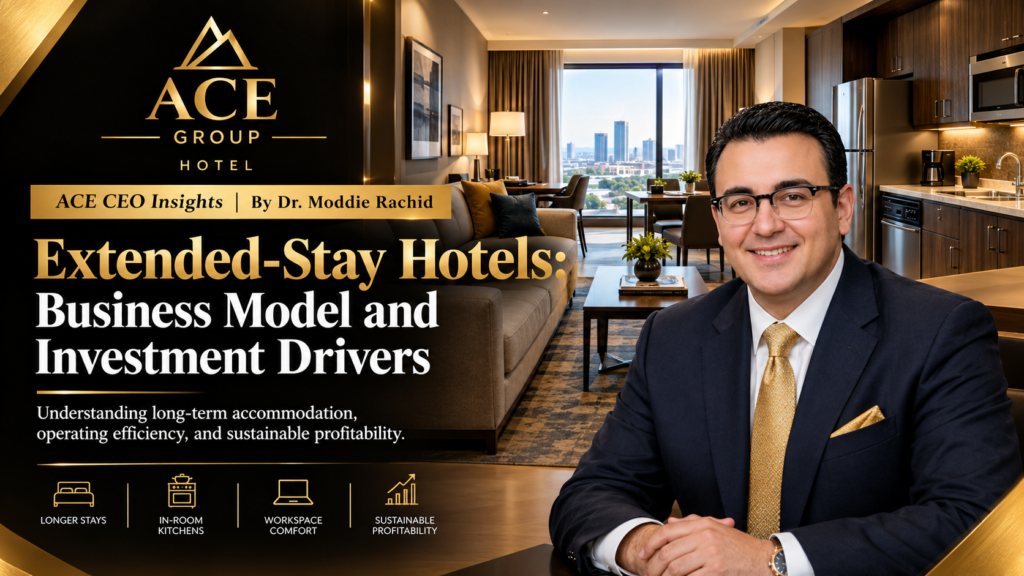
Understanding the economics of long-term accommodation and how hotel owners can build sustainable profitability.
1. Understanding the Extended-Stay Hotel Concept
Extended-stay hotels serve guests who need accommodation for several weeks or months rather than just a few nights. Their target markets include corporate professionals, project teams, relocating families, medical travelers, and guests between permanent residences.
Unlike traditional hotels, these properties are designed around longer stays, offering practical amenities such as kitchenettes, laundry facilities, comfortable workspaces, and flexible accommodation options.
The business objective is simple: deliver residential comfort with professional hotel services while maintaining a sustainable operating model.
2. The Economics of Extended-Stay Hotels
The financial advantage of extended-stay hotels comes from the potential to generate more predictable occupancy and reduce certain costs associated with frequent guest turnover.Longer stays can reduce check-in and check-out workloads, housekeeping frequency, distribution expenses per occupied room, and the pressure to constantly acquire new guests.However, lower room rates do not automatically mean higher profitability. Extended-stay operators must carefully manage utilities, maintenance, labor, supplies, and the cost of servicing occupied rooms.
The real measure of success is not occupancy alone, but the operating profit generated by each available room.
3. Revenue Management: Selling Length of Stay, Not Just Room Nights
Successful extended-stay operators develop pricing strategies around the duration of a guest’s stay, seasonal demand, corporate contracts, and local market conditions.
Weekly and monthly rates can encourage longer bookings and improve demand visibility. Nevertheless, discounts must be balanced against operating costs and the revenue that could be earned from shorter, higher-paying stays.
A strong revenue strategy combines negotiated corporate business, direct bookings, project-based accommodation, and carefully managed online distribution.
4. Operational Efficiency and Guest Experience
Extended-stay guests expect more than a place to sleep. They need reliable internet, functional kitchens, clean and comfortable living spaces, responsive maintenance, and a consistent sense of security.
Housekeeping schedules should reflect length of stay without compromising hygiene. Preventive maintenance is particularly important because guests depend on room facilities for everyday living.The General Manager must ensure that operational efficiency never becomes an excuse for reducing service quality.
5. What Investors Must Evaluate
Before investing in an extended-stay property, owners should assess:-
Market demand:
Corporate activity, infrastructure projects, healthcare facilities, and relocation trends.-
Competitive positioning:
Existing extended-stay supply, alternative accommodation, and achievable market rates.
Operating costs:
Labor, utilities, maintenance, housekeeping, and replacement reserves.
Revenue stability:
Corporate agreements, booking patterns, average length of stay, and customer concentration.
Asset suitability:
Room layouts, kitchen facilities, building systems, and the cost of conversion where applicable.
Investors should also evaluate local regulations, licensing requirements, and the financial implications of extended occupancy.
6. The General Manager’s Role in Long-Term Profitability
The General Manager must align commercial strategy with operational discipline. This requires monitoring occupancy, average daily rate (ADR), revenue per available room (RevPAR), departmental expenses, and gross operating profit (GOP).
Equally important are guest retention, corporate account relationships, maintenance standards, and employee productivity.
A property can achieve high occupancy while underperforming financially if rates are poorly structured or operating costs are uncontrolled.
The GM’s responsibility is to convert stable demand into sustainable operating profit and long-term asset value.
Conclusion:
Building a Sustainable Extended-Stay BusinessExtended-stay hotels offer an attractive business model when the location, demand profile, pricing strategy, and operating structure are aligned.
Their competitive advantage lies not simply in longer bookings, but in the ability to combine predictable demand, efficient operations, and a guest experience designed for everyday living.
For hotel owners and investors, the objective is clear: build a business that delivers consistent guest satisfaction, disciplined operating performance, and sustainable long-term returns.
Dr. Moddie Rachid
Group CEO | Hospitality Consultant | Hotel Turnaround & Asset Growth SpecialistACE Group Hotel — Hospitality Management • Hotel Investment • Asset Management
Read more articles;
ACE CEO Insights – ACE Group USA
https://acegroupusa.com/category/ace-ceo-insights/