
ACE CEO Insights | By Dr. Moddie Rachid
Introduction:
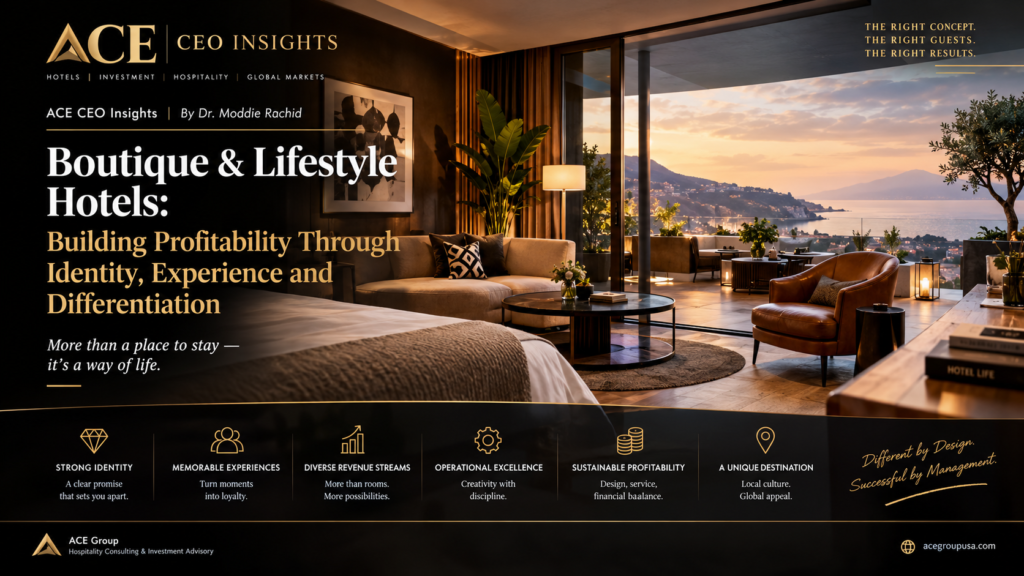
More Than a Place to Stay
In today’s competitive hospitality industry, some hotels compete through scale, brand recognition, and standardized services.
Boutique and lifestyle hotels often pursue a different strategy:
they compete through identity, design, atmosphere, personalization, and distinctive guest experiences.However, creating a beautiful hotel with a memorable concept is only the beginning.
The real challenge is turning that identity into a commercially sustainable business.A successful boutique or lifestyle hotel must balance creativity with operational discipline, guest experience with cost control, and differentiation with long-term profitability.
1. Understanding the Difference
Boutique hotels are typically smaller, distinctive properties characterized by individual design, a strong sense of place, and personalized service. They often emphasize character and intimacy rather than scale.
Lifestyle hotels focus on a particular way of living, expressed through design, social spaces, food and beverage, wellness, culture, and guest interaction. They may operate independently or as part of a major hotel group.Although these concepts overlap, they are not identical.
A boutique hotel does not automatically offer a lifestyle experience, and a lifestyle hotel does not necessarily have a small room inventory.
For investors and hotel operators, understanding this distinction is essential because the concept influences the target market, operating model, staffing requirements, capital investment, and revenue strategy.
2. Identity Is a Business Strategy
A hotel’s identity should be more than an attractive interior or a marketing slogan. It must communicate a clear promise to the guest.That promise should be reflected in every major touchpoint, including architecture, room design, service style, music, food and beverage, staff behavior, and the surrounding destination.
When these elements work together, the hotel becomes easier to distinguish from competing properties.A strong identity can support pricing power and customer loyalty, but only when guests perceive genuine value.
Design alone cannot justify a premium rate if service quality, comfort, cleanliness, and overall experience fail to meet expectations.
3. Turning Guest Experience into Revenue
Boutique and lifestyle hotels have opportunities to generate revenue beyond room sales.Depending on their positioning, these may include:
Signature restaurants, bars, and social dining experiences.
Rooftop venues, events, and private functions.- Wellness, fitness, and curated local experiences.
Partnerships with local artists, designers, and businesses.
Exclusive packages designed around the hotel’s identity.
The objective is not to add as many revenue streams as possible. Each activity should strengthen the concept, appeal to the target market, and generate an acceptable financial return.
A restaurant that attracts local customers may improve the hotel’s visibility and create an additional source of income. However, if its labor, food, energy, and operating costs are poorly controlled, higher revenue may not translate into higher profit.Revenue creates opportunity; disciplined operations determine how much value the business retains.
4. The Economics Behind the Experience
Boutique and lifestyle hotels may command premium rates, but their financial performance depends on more than room pricing.
Key considerations include:
Average Daily Rate (ADR): The average room revenue earned per occupied room.
Revenue per Available Room (RevPAR): Room revenue measured against the total available room inventory, combining the effects of rate and occupancy.
Gross Operating Profit (GOP): The operating profit generated before deductions and charges that fall outside the property’s operating departments, depending on the accounting framework used.
Total Revenue and Departmental Profitability: The contribution of rooms, food and beverage, events, and other revenue-generating departments.
Labor Productivity: Whether staffing levels and schedules match demand without compromising the guest experience.
Return on Investment: Whether the capital committed to design, construction, refurbishment, and positioning produces an acceptable return.
A hotel can achieve impressive room rates while delivering disappointing financial results if its investment costs, payroll, purchasing, maintenance, or departmental expenses are excessive.
The general manager must therefore understand both the guest experience and the financial consequences of operational decisions.
5. Design Excellence Must Be Supported by Operational Excellence
One of the most common strategic risks is creating a concept that looks exceptional but is difficult or expensive to operate.
Unusual room layouts, specialized materials, elaborate lighting, bespoke furniture, and complex food and beverage concepts may enhance differentiation.
They can also increase maintenance requirements, replacement costs, training needs, and operational complexity.
These decisions should be evaluated before opening, not after problems begin to affect the guest experience or the operating budget.The most successful concept is not necessarily the most expensive or visually dramatic. It is the one that delivers a distinctive experience while remaining operationally practical and financially sustainable.
6. The General Manager’s Role
Managing a boutique or lifestyle hotel requires a balance of commercial awareness, operational discipline, and creative understanding.
The general manager must ensure that:-
The hotel’s identity is clearly understood by every department.
Service standards remain consistent across all shifts.
Employees are trained to deliver personalized hospitality within clear operating guidelines.
Revenue strategies reflect actual market demand and competitive positioning.
Purchasing, payroll, inventory, and departmental expenses are controlled.
Guest feedback is converted into measurable improvements.
The hotel’s concept evolves without losing its original purpose.
Personalized service should never be confused with an absence of standards. Clear procedures allow employees to deliver consistent quality while using professional judgment to respond to individual guest needs.
7. Marketing Must Match the Actual Experience
Boutique and lifestyle hotels often rely heavily on visual storytelling, digital marketing, social media, online reviews, and reputation.These channels can create awareness and attract the right audience, but they also raise expectations.
If the marketing promises an exceptional experience that the operation cannot consistently deliver, negative reviews can undermine the hotel’s positioning.
The commercial strategy must therefore connect the promise made before arrival with the experience delivered during the stay.Repeat business, recommendations, guest satisfaction, and direct bookings can help strengthen long-term performance when supported by genuine quality and a clear market proposition.
8. Common Mistakes That Undermine Profitability
Several mistakes can weaken otherwise promising boutique and lifestyle hotel concepts:
1. Investing heavily in design without validating market demand.
2. Targeting an unclear audience and attempting to appeal to everyone.
3. Pricing rooms according to appearance rather than competitive demand and perceived value.
4. Adding restaurants, bars, and events without evaluating their financial contribution.
5. Underestimating maintenance, payroll, training, and replacement costs.
6. Allowing inconsistent service to damage the hotel’s identity.
7. Focusing on occupancy and revenue while neglecting profitability and return on investment.
Avoiding these mistakes requires a disciplined feasibility study, a realistic operating budget, a well-defined concept, and continuous performance monitoring.
Conclusion:
Differentiation Must Deliver Results
Boutique and lifestyle hotels demonstrate that a hotel does not need to compete solely through size or international brand recognition.
A distinctive concept, a meaningful guest experience, and a strong connection with the destination can create a valuable competitive position.
Yet differentiation is not an end in itself.The long-term success of these hotels depends on the ability to translate identity into guest preference, guest preference into sustainable revenue, and revenue into profitable operations.
For owners and investors, the objective is to create a hotel that is both desirable to guests and financially sound.
For general managers, the responsibility is to protect the concept while ensuring that every department contributes to consistent service, operational efficiency, and business performance.
A distinctive hotel attracts attention. A well-managed hotel turns that attention into lasting value.
Dr. Moddie Rachid
ACE CEO Insights | ACE Group Hotel
Read more articles;
https://acegroupusa.com/category/ace-ceo-insights/