
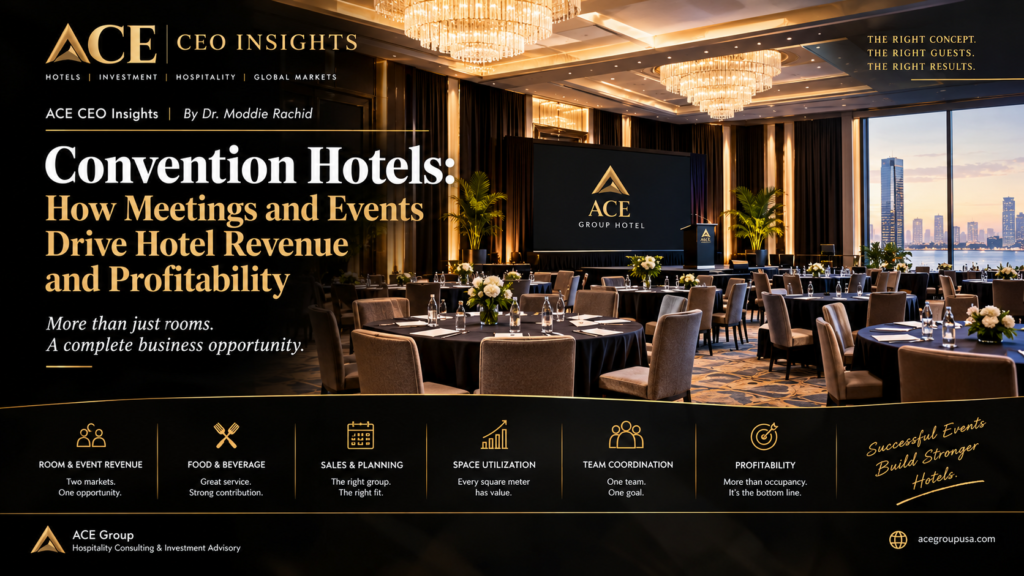
ACE CEO Insights | By Dr. Moddie Rachid
Introduction:
A Different Hotel Business Model
Convention hotels operate in a more complex environment than traditional room-focused hotels.
Their success depends not only on selling guest rooms, but also on coordinating conferences, corporate meetings, exhibitions, banquets, food and beverage operations, and large-scale events.This creates significant revenue opportunities, but it also introduces operational complexity.
A successful event requires precise coordination between sales, event planning, front office, housekeeping, food and beverage, culinary operations, engineering, and finance.
For hotel owners and general managers, the objective is not simply to fill rooms or book ballrooms. It is to convert the combined demand for accommodation, meetings, and events into sustainable operating profit.
1. Understanding the Convention Hotel Business
Convention hotels typically serve corporate meetings, association conferences, exhibitions, incentive groups, social events, and large business gatherings.Depending on their location and facilities, they may attract international conventions, government delegations, wedding groups, and destination events.
Unlike a hotel that depends primarily on individual travelers, a convention hotel often manages demand through group contracts negotiated months or even years in advance.These contracts can provide valuable visibility into future business.
However, the hotel must evaluate each opportunity carefully, considering room rates, event-space requirements, catering commitments, staffing, concessions, and the possibility of displacing more profitable business.
2. Revenue Goes Beyond the Guest Room
A convention hotel may generate revenue from several interconnected sources:
Guest rooms and group accommodation.
Meeting rooms, ballrooms, and conference facilities.
Banquets, catering, and food and beverage.
Exhibition space and event-related services.
Audiovisual equipment and technical support.
Parking, business services, and selected additional amenities.
The real opportunity lies in understanding how these revenue streams support one another.
A conference may generate substantial room revenue while also creating demand for breakfast, coffee breaks, lunches, dinners, and evening receptions.However, not every additional service creates an attractive profit contribution.
The hotel must evaluate the direct costs and operational resources required to deliver each component.The best business is not necessarily the event with the largest contract value. It is the business that contributes the most appropriate financial return while fitting the hotel’s capacity and strategic positioning.
3. Evaluate Total Business Value Before Accepting a Group
One of the most important responsibilities of hotel sales and revenue management is evaluating the total value of a group opportunity.
A group requesting a large room block may appear attractive, but the analysis should consider:
Expected room revenue and the agreed group rate.- Food and beverage revenue and associated costs.
Meeting-space rental and any waived rental charges.- Complimentary rooms, discounts, and other concessions.
Labor, setup, cleaning, equipment, and energy requirements.
Booking restrictions and cancellation provisions.
The opportunity cost of turning away alternative business.
For example, a group requiring a large number of rooms during a high-demand period may be less attractive if it demands substantial discounts and consumes inventory that could otherwise sell at higher rates.
Conversely, a group arriving during a traditionally weak period may provide valuable base demand, particularly when its catering and event requirements generate additional contribution.
The general manager should ensure that commercial decisions are based on a complete business evaluation rather than room revenue alone.
4. Food and Beverage: Opportunity and Operational Risk
Food and beverage can be a major component of convention hotel revenue, particularly when conferences include multiple meals, coffee breaks, receptions, and formal banquets.Yet large catering contracts create pressure on purchasing, kitchen production, staffing, inventory management, and service timing.
Profitability depends on several disciplines:
Menu engineering:
Designing menus that satisfy client expectations while maintaining appropriate food costs and production efficiency.
Portion control:
Maintaining consistent serving sizes and minimizing unnecessary waste.
Purchasing and inventory:
Ordering according to confirmed requirements, managing storage correctly, and monitoring stock movement.
Labor planning:
Scheduling kitchen, service, stewarding, and setup teams according to actual event requirements.
Production coordination:
Aligning banquet event orders, final guest counts, dietary requirements, and service schedules before execution.
A profitable catering operation is not achieved simply by increasing the number of guests served. It requires precise planning and control throughout the event cycle.
5. The Banquet Event Order: Turning the Contract into Execution
The Banquet Event Order (BEO) is a critical operational document in many convention hotels.It communicates the agreed event requirements to the departments responsible for delivery, including the event schedule, room setup, expected attendance, menu, service timing, audiovisual needs, special requests, and other operational details.
Its value depends on accuracy, timely distribution, clear accountability, and updates whenever the client’s requirements change.When sales promises are not communicated correctly to operations, the consequences may include incorrect room setups, delayed service, food waste, overtime, client complaints, and avoidable financial losses.
A disciplined pre-event briefing and a clear process for approving last-minute changes can significantly reduce these risks.
6. Space Utilization and Event Scheduling
Meeting rooms and ballrooms represent valuable hotel assets.
Their profitability depends on how effectively the hotel allocates space, time, labor, and equipment.
A room used for one large event may generate substantial revenue, but it may also prevent the hotel from hosting several smaller functions.Management should therefore evaluate event-space utilization alongside the revenue and contribution generated by each booking.
Important considerations include setup and breakdown time, room turnaround, simultaneous events, access routes, storage requirements, kitchen capacity, and service-team availability.
The objective is not to keep every room occupied at all times. It is to maximize the economic value of available space without compromising service quality or operational feasibility.
7. Sales, Operations, and Revenue Management Must Work as One Team
Convention hotels cannot perform effectively when departments operate in isolation.Sales may secure the contract, but operations must deliver it.
Revenue management protects inventory and pricing, finance evaluates financial performance, and event planning coordinates the details that determine whether the client receives what was promised.8
A strong operating model establishes clear responsibilities before the event is confirmed and maintains communication through execution and final billing.Post-event reviews can identify service failures, cost overruns, client feedback, and opportunities to improve future contracts.
This coordination is particularly important when several conferences or banquets take place simultaneously.
8. Measure Profitability, Not Just Activity
Convention hotels require performance measures that go beyond occupancy and total revenue.
Useful indicators include:
ADR and RevPAR:
Assessing room pricing and room revenue performance.-
Group contribution:
Evaluating the financial contribution of contracted group business.-
Food cost percentage:
Monitoring food costs against relevant food revenue.
Labor productivity:
Comparing staffing resources with business volume and service requirements.-
Meeting-space revenue and utilization:
Understanding the commercial performance of event facilities.
GOP:
Evaluating the hotel’s overall operating profitability.
Client satisfaction and repeat business:
Measuring the quality and commercial sustainability of the event experience.Metrics must be interpreted together.
High occupancy can coexist with weak profitability, and high banquet revenue can conceal excessive labor costs or food waste.
Management should establish clear reporting practices and evaluate results against budgets, forecasts, and appropriate operational benchmarks.
9. Common Mistakes That Reduce Convention Hotel Profitability
Several mistakes can undermine an otherwise successful convention business:
1. Accepting group contracts without evaluating their total financial contribution.
2. Offering excessive discounts or concessions to secure large events.
3. Failing to communicate confirmed requirements to operating departments.
4. Underestimating setup, breakdown, overtime, and equipment costs.
5. Treating banquet revenue as proof of profitability without reviewing its costs.
6. Scheduling multiple events beyond the hotel’s operational capacity.
7. Neglecting post-event financial reviews and client feedback.Avoiding these mistakes requires disciplined commercial evaluation, accurate event documentation, strong departmental coordination, and continuous performance monitoring.
Conclusion:
Every Event Must Deliver Value
Convention hotels have the potential to generate substantial revenue by combining accommodation, meeting facilities, catering, and event services.
However, size and volume alone do not guarantee success.Sustainable performance requires the general manager to connect sales strategy with operational capability, cost control, service standards, and financial accountability.
When every department understands its responsibilities and every contract is evaluated on its total business value, the hotel is better positioned to protect margins, strengthen client relationships, and build repeat business.
A successful convention hotel does more than host events. It turns every event into a well-managed business opportunity.
Dr. Moddie Rachid
ACE CEO Insights | ACE Group Hotel
read more articles;
ACE CEO Insights – ACE Group USA
https://acegroupusa.com/category/ace-ceo-insights/