
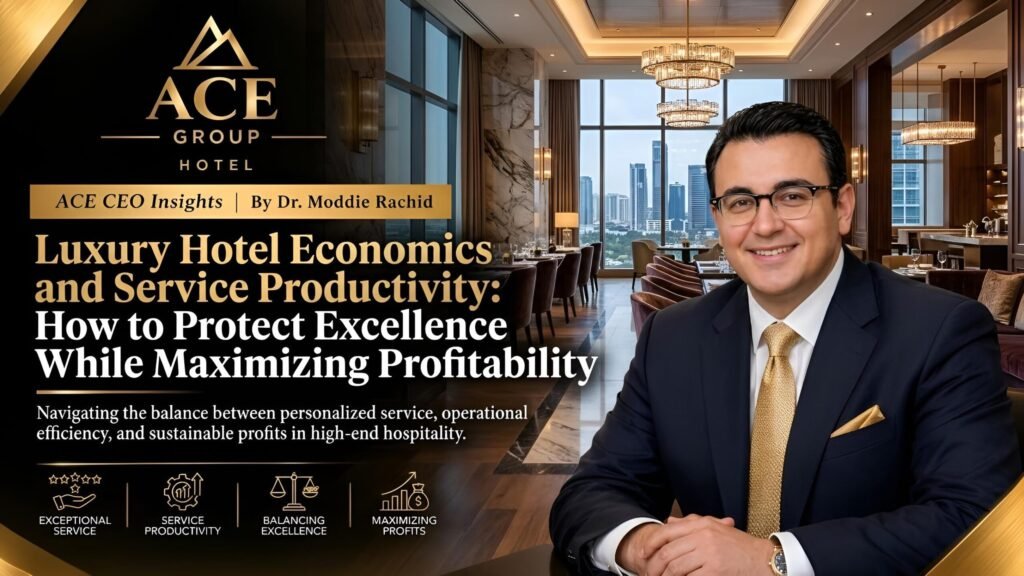
ACE CEO Insights | By Dr. Moddie Rachid
Luxury hospitality is built on a promise: exceptional experiences, personalized service, superior quality, and attention to detail. However, behind every successful luxury hotel lies a complex business model that must balance these expectations with financial performance.
For hotel owners, investors, and general managers, the challenge is not simply to deliver luxury. It is to deliver luxury consistently, efficiently, and profitably.
A luxury hotel that generates impressive revenue but struggles with excessive payroll, inefficient operations, or uncontrolled operating expenses may appear successful while gradually eroding its financial value.The real objective is to build a hotel where exceptional guest experiences and sustainable profitability reinforce each other.
1. Understanding the Economics of Luxury Hotels
Luxury hotels operate under a different set of expectations from many midscale and upscale properties. Guests are often willing to pay premium rates, but they also expect a level of service that must be delivered consistently across every department.
This creates both an opportunity and a responsibility.Premium Average Daily Rate (ADR) can support stronger revenue per available room (RevPAR), but higher room rates alone do not guarantee higher profitability. Labor costs, amenities, food and beverage operations, maintenance, energy consumption, and the complexity of personalized services can significantly affect the bottom line.General managers must therefore understand the relationship between revenue quality and operating costs.
Three questions should guide financial decisions:
Are we generating the right revenue from the right customer segments?
Are our operating expenses aligned with the experience we promise?
Are our commercial and operational strategies improving profitability without weakening our positioning?
Luxury is not defined by how much a hotel spends. It is defined by the value guests perceive and the consistency with which that value is delivered.
2. Revenue Strategy: Selling Value, Not Just Rooms
Luxury hotels should avoid competing primarily on price. Their commercial strategy must communicate differentiation through location, design, service, exclusivity, reputation, and the overall guest experience.Revenue management must consider more than occupancy.
A hotel achieving high occupancy at discounted rates may generate less revenue and profit than a competitor selling fewer rooms at stronger rates with a better customer mix.
The general manager and revenue management team should regularly evaluate:
ADR: The average rate achieved for rooms sold.
RevPAR: Room revenue generated per available room.
Total Revenue per Available Room (TRevPAR): The broader revenue contribution from rooms, restaurants, bars, spa facilities, and other hotel services.
Revenue mix: The contribution of different customer segments, distribution channels, and ancillary services.
The objective is to maximize profitable demand rather than occupancy at any cost.Corporate accounts, luxury leisure travelers, premium tour operators, direct bookings, and special experiences should be evaluated according to their net contribution, not simply their volume.
An effective luxury hotel sells the value of its experience while protecting its pricing position.
3. Service Productivity: The Balance Between People and Performance
People are among the most important assets in luxury hospitality. Employees create the personal connections, anticipate guest needs, and resolve problems that distinguish an exceptional property from an ordinary one.Yet labor is also one of the largest controllable operating expenses.
The answer is not indiscriminate staff reductions. Reducing staffing without understanding service demand can damage guest satisfaction, employee morale, and the hotel’s reputation.
Instead, service productivity should focus on deploying the right people, with the right skills, at the right time.
Practical priorities include:
Forecasting staffing requirements according to occupancy, guest profiles, events, and seasonal demand.
Cross-training employees where appropriate, without compromising specialist expertise.
Simplifying repetitive administrative tasks through suitable technology.
Improving communication between departments to reduce duplicated work and service delays.
Measuring productivity alongside guest satisfaction and service quality.
For example, a front office team that receives accurate room-status information from housekeeping can manage arrivals more efficiently and reduce unnecessary guest waiting.Similarly, well-coordinated concierge, food and beverage, and housekeeping teams can anticipate guest needs instead of constantly reacting to problems.The objective is not to make luxury service less personal.
It is to remove operational inefficiencies that prevent employees from delivering personal service.4. Controlling Costs Without Compromising LuxuryCost management in a luxury hotel requires discipline and judgment.Some expenses directly influence the guest experience and deserve investment.
Others may have limited impact on perceived value and can be optimized without affecting quality.General managers should examine major cost categories individually rather than impose identical percentage reductions across all departments.
Key priorities include:
Payroll and scheduling:
Match staffing levels to demand while protecting service standards and employee development.
Food and beverage:
Monitor food cost, purchasing prices, menu engineering, portion consistency, inventory, and waste.
Energy and utilities:
Improve equipment efficiency, monitor consumption, and introduce practical conservation measures without compromising guest comfort.
Procurement:
Consolidate purchasing where beneficial, negotiate supplier agreements, and evaluate total cost and quality rather than choosing the cheapest option automatically.
Maintenance:
Use preventive maintenance to reduce emergency repairs, protect the asset, and minimize disruptions to guests.
Amenities and supplies:
Review consumption patterns and specifications to identify waste while maintaining the standards expected by the hotel’s target market.
Every department should understand its financial responsibilities. However, savings should be evaluated against their operational consequences.A cheaper product that damages guest perception or a staffing reduction that creates service failures may cost far more than it saves.
5. Protecting GOP Through Departmental Accountability
Gross Operating Profit (GOP) is an essential indicator of hotel operating performance.
It reflects the relationship between operating revenue and the expenses required to generate it, before certain undistributed operating expenses and fixed charges are accounted for according to the property’s reporting framework.
Luxury hotel leaders should monitor GOP alongside departmental performance, revenue indicators, payroll productivity, and guest satisfaction.
A useful management dashboard should include:
Occupancy, ADR, and RevPAR.
Total operating revenue and revenue mix.- Departmental profit margins.
Payroll cost and productivity indicators.- Food cost and other major controllable expenses.
GOP and GOP margin.
Guest satisfaction, complaints, and service recovery performance.
Results should be compared with budget, forecast, historical performance, and appropriate competitive benchmarks.The general manager must also distinguish between revenue growth and profit growth.
If revenue increases while operating expenses rise even faster, the hotel’s financial performance may deteriorate despite apparently positive commercial results.Department heads should therefore understand not only their service responsibilities but also how their decisions affect the hotel’s financial results.
Financial accountability must become part of the hotel’s operating culture, not merely a monthly reporting exercise.
6. Technology, Personalization, and the Guest Experience
Technology can improve luxury hotel productivity when it removes friction from the guest journey and supports better decisions.Integrated property management systems, customer relationship management platforms, revenue management tools, and workforce scheduling solutions can improve coordination and provide managers with more reliable information.
Guest preference records can help teams personalize experiences, while automation can reduce repetitive administrative work.However, technology should support hospitality rather than replace meaningful human interaction.
A luxury guest may appreciate a seamless digital check-in, but the same guest may also value a knowledgeable concierge, a thoughtful welcome, or an employee who remembers a relevant preference.
The strongest approach combines operational technology with human judgment.Investment decisions should be evaluated through measurable outcomes: time saved, fewer errors, improved conversion, stronger guest satisfaction, better labor productivity, or increased profitable revenue.
Technology is valuable when it strengthens both the guest experience and the business model.
7. The General Manager’s Role: Connecting Excellence With Profitability
The luxury hotel general manager must lead beyond departmental boundaries.Commercial teams may focus on revenue, operations on service delivery, finance on cost control, and human resources on staffing and development.
The GM must bring these priorities together within one coherent business strategy.
This requires a consistent management rhythm:-
Daily operational reviews to address immediate service and business issues.-
Weekly performance meetings to review demand, staffing, revenue opportunities, and cost variances.
Monthly financial reviews to evaluate profitability, forecasts, and corrective actions.- Ongoing leadership development to strengthen accountability, employee engagement, and service culture.
The GM must also protect the hotel’s long-term value. Delaying essential maintenance, underinvesting in employee development, or reducing quality to achieve a short-term financial target can create larger costs later.Sustainable performance requires a clear understanding of the difference between eliminating waste and undermining the hotel’s competitive advantage.
The best luxury hotel leaders know when to invest, when to optimize, and when to protect standards regardless of short-term pressure.
Conclusion:
Luxury Must Be an Experience and a Sustainable BusinessLuxury hospitality does not require a choice between exceptional service and strong financial performance.When pricing strategy, service productivity, cost discipline, technology, and leadership work together, a hotel can protect its identity while improving profitability.
The role of the general manager is to ensure that every investment supports a clear purpose, every department understands its contribution, and every operational decision is evaluated against both guest expectations and business objectives.
For owners and investors, the most valuable luxury hotel is not necessarily the property that spends the most or charges the highest rates. It is the property that consistently delivers a differentiated experience, generates sustainable operating profit, protects its physical assets, and strengthens its long-term market position.
True luxury is not measured by expenditure alone. It is measured by the experience delivered, the value created, and the profitability sustained over time.
Dr. Moddie Rachid
Group CEO | Hospitality Consultant | Hotel General Manager | Hotel Turnaround & Asset Growth Specialist
ACE Group Hotel | Hospitality Management • Hotel Investment • Asset Management
Sharing practical hospitality knowledge to help hotel owners, investors, and leaders build stronger businesses and lasting value.

Read more articles;
https://acegroupusa.com/category/ace-ceo-insights/