
ACE CEO Insights | By Dr. Moddie Rachid
Introduction
Technology has become a major investment area in the hospitality industry. From Property Management Systems and revenue management platforms to artificial intelligence, automation, and smart hotel solutions, technology is changing how hotels operate and compete.
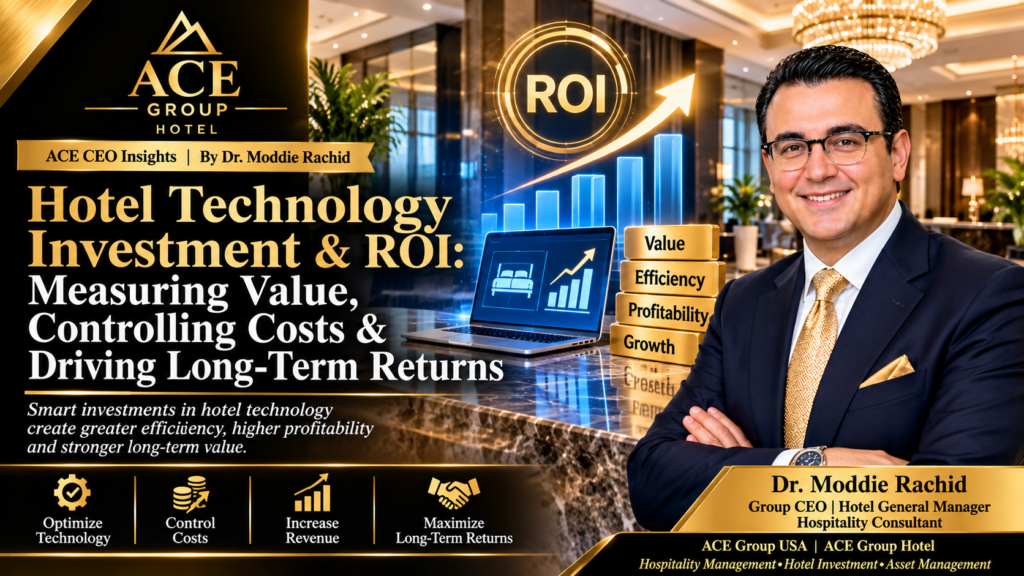
However, investing in technology does not automatically improve hotel performance.The real question for hotel owners, investors, and General Managers is not how advanced a technology solution is, but how much measurable business value it creates.Every technology investment should contribute to operational efficiency, revenue growth, cost control, guest satisfaction, or long-term asset value.
Technology should be treated as a business investment, not simply an operating expense.
1. Start with Business Objectives, Not Technology Trends
One of the most common mistakes in hotel technology investment is purchasing systems because competitors are using them or because they appear innovative.
Before approving any investment, management must identify the operational or financial problem that needs to be solved.
For example:
– Is the hotel experiencing high labor costs?
– Are revenue management decisions based on outdated information?
– Are departmental systems disconnected?
– Is guest communication inefficient?- Are maintenance expenses increasing?
– Is management spending too much time on manual reporting?
Technology should address specific business challenges.The objective is to invest in solutions that produce measurable improvements rather than accumulate expensive systems with limited operational value.
2. Understanding the Total Cost of Technology Investment
The purchase price of a technology system represents only part of its actual cost.Hotel management must consider the Total Cost of Ownership (TCO), including:
– Initial installation and implementation.- Software licenses and subscription fees.
– Hardware and infrastructure.
– System integration.- Employee training.
– Technical support and maintenance.- Future upgrades and replacement.
A system that appears affordable initially may become expensive over time if its ongoing costs are not properly evaluated.
General Managers and Financial Controllers should assess the complete financial commitment before approving major technology investments.
3. Measuring Return on Investment (ROI)
Return on Investment is one of the most important tools for evaluating technology performance.
A simple ROI calculation is:ROI = (Financial Benefits − Investment Cost) ÷ Investment Cost × 100
For example, if a hotel invests $100,000 in an automation solution and generates $130,000 in measurable financial benefits over an agreed evaluation period, the net benefit is $30,000.
The resulting ROI is 30%.However, management must use realistic assumptions and distinguish between actual financial savings, additional revenue, and non-financial benefits.
A successful investment should demonstrate measurable value within a reasonable timeframe.
4. Technology Investment and Operational Efficiency
One of the strongest reasons to invest in hotel technology is the opportunity to improve operational productivity.Integrated systems can reduce repetitive administrative work, improve departmental coordination, and help management allocate resources more effectively.
For example:- Automation can reduce manual administrative tasks.
– Digital housekeeping systems can improve room turnaround.
– Predictive maintenance can reduce unexpected equipment failures.
– Integrated reporting can improve financial monitoring.
– Revenue management systems can support better pricing decisions.
The real financial benefit comes when these improvements translate into lower operating costs, better productivity, and stronger hotel performance.
5. Protecting Revenue and Increasing Profitability
Technology should also contribute to the hotel’s revenue strategy.Revenue management systems can help analyze demand patterns, monitor competitors, and optimize room pricing.Customer relationship management platforms can support guest retention and personalized marketing.
Digital distribution systems can improve booking management and provide better visibility into channel performance.However, increased revenue does not necessarily mean increased profitability.
Management must also consider distribution costs, commissions, technology fees, and the additional operating expenses associated with higher business volumes.
The objective is to generate profitable revenue, not simply higher sales.
6. Evaluating Technology Through Hotel Performance Indicators
Every major technology investment should be connected to relevant Key Performance Indicators (KPIs).Depending on the solution, management should monitor:
– Revenue per Available Room (RevPAR).
– Gross Operating Profit (GOP).
– Gross Operating Profit per Available Room (GOPPAR).
– Labor Cost Percentage.- Cost per Occupied Room.- Guest Satisfaction Scores.
– Employee Productivity.
– Maintenance Cost per Available Room.
For example, if a new housekeeping system is introduced, management should evaluate its impact on room turnaround time, labor productivity, and room availability.
If a revenue management platform is implemented, the hotel should measure its contribution to pricing decisions, RevPAR, and overall profitability.Technology performance must ultimately be evaluated through business results.
7. The General Manager’s Role in Technology Investment
The General Manager must act as a bridge between technology, operations, and financial performance.
Before approving a major investment, the GM should work closely with Finance, IT, department heads, and ownership representatives to evaluate its business case.Responsibilities include:
– Defining clear investment objectives.
– Reviewing implementation costs.
– Evaluating expected financial returns.- Ensuring employee training.
– Monitoring implementation progress.
– Measuring actual results against projections.
Technology should never be introduced without a clear operational purpose and management accountability.
A successful GM understands that every investment must contribute to the hotel’s overall business strategy.
8. Building Long-Term Asset Value Through Technology
The value of hotel technology extends beyond immediate cost savings.
Modern systems can improve operational consistency, protect digital assets, strengthen guest relationships, and support better management decisions.For hotel owners and investors, these improvements can contribute to stronger financial performance and a more competitive property.However, technology must be maintained, updated, and integrated into a long-term asset management strategy.
The objective is not to invest continuously in every new technological trend, but to build a reliable digital infrastructure that supports sustainable hotel performance.
Conclusion:
Invest in Technology That Delivers ResultsTechnology is becoming an essential part of modern hotel management, but successful investment requires more than selecting advanced systems.
It requires financial discipline, clear objectives, operational understanding, and continuous performance measurement.
Hotel owners and General Managers must evaluate technology based on its ability to improve productivity, increase profitable revenue, control costs, enhance guest satisfaction, and protect long-term asset value.
My philosophy is simple:Do not invest in technology because it is new. Invest because it creates measurable value.
The strongest hotels of the future will not necessarily be those that spend the most on technology, but those that make the smartest investments and turn innovation into sustainable financial results.
Dr. Moddie Rachid
Group CEO | Hotel General Manager | Hospitality ConsultantHotel Turnaround & Asset Growth Specialist
ACE Group USA | ACE Group HotelHospitality Management • Hotel Investment • Asset Management

Read More Articles;
https://acegroupusa.com/category/ace-ceo-insights/
Sharing practical hospitality knowledge to help hotel owners, investors, and leaders build stronger businesses and lasting value.