The Difference Between Owning a Hotel and Building a Valuable Hotel Asset
ACE CEO Insights | By Dr. Moddie Rachid
There is a difficult truth in the hotel business that many investors do not want to hear:
Buying a hotel does not make you a hotel owner.
It makes you the owner of a piece of real estate that happens to operate as a hotel.The difference is enormous.I have seen investors spend millions acquiring a property, negotiate a management agreement with a recognized hotel operator, celebrate the opening, and then assume the job is finished.It is not.The acquisition is only the beginning.A hotel is not simply a building, a flag, a lobby, and a collection of rooms.It is a complex operating business sitting on top of a capital-intensive real estate asset.And the owner who understands only one side of that equation can easily destroy value while believing the hotel is performing well.
Some Owners Are Better at Buying Hotels Than Owning Them
This is not an insult.It is an investment reality.Some investors are excellent at raising capital, negotiating acquisitions, financing transactions, and closing deals.But owning a hotel requires a completely different discipline.A serious hotel owner must understand:- Operations- Revenue management- Labor productivity- Commercial strategy- Capital expenditure- Brand positioning- Guest experience- Asset management- Financial performance- Market positioning- Management contracts- Return on invested capital- Exit strategy
Most importantly, the owner must understand how today’s operating decisions affect tomorrow’s asset value.That is where many ownership strategies fail.
A Hotel Can Be Busy and Still Be a Bad Investment
One of the biggest mistakes I see is confusing operational activity with investment performance.The hotel is full.Revenue is growing.RevPAR looks healthy.The General Manager is reporting positive momentum.Everyone is celebrating.But then the owner asks the only question that ultimately matters:”How much value did we actually create?”That question changes the conversation.RevPAR is important.Occupancy is important.ADR is important.GOP is important.But none of these numbers, by themselves, tells the owner whether the investment is becoming more valuable.A hotel can increase occupancy while destroying rate.It can increase revenue while losing margin.It can produce strong GOP while underinvesting in the physical asset.It can look excellent operationally while producing disappointing returns to equity.Performance is not the same thing as value creation.
The Operator Runs the Hotel. The Owner Must Protect the Asset.
This distinction is critical.A professional hotel operator has a responsibility to operate the business.The owner has a responsibility to protect the investment.Those responsibilities overlap, but they are not identical.The operator may focus on:”How do we achieve this year’s budget?”The owner should also be asking:”What does this decision do to the value of the asset five years from now?”That means challenging assumptions.It means questioning capital expenditures.It means analyzing departmental profitability.It means understanding whether the hotel is achieving sustainable rate growth or simply buying occupancy.It means understanding whether the management company and ownership are truly aligned.Research on hotel owner-operator relationships has found that stronger alignment of objectives is associated with better hotel performance.A sophisticated owner therefore does not simply hire an operator and disappear.A sophisticated owner creates accountability.
The Most Dangerous Sentence in Hotel Ownership
I have heard this sentence too many times:«”That’s the operator’s job.”»No.Operating the hotel is the operator’s job.Understanding whether the operator is creating value for you is the owner’s job.If an owner cannot read a hotel P&L, understand the relationship between ADR and occupancy, challenge a labor budget, evaluate a renovation proposal, question a management fee, or understand what is happening below GOP, then the owner is operating with an enormous information disadvantage.And information disadvantage is expensive.Today’s sophisticated hotel ownership environment increasingly demands owners who can challenge operators with better questions, stronger benchmarks, commercial insight, forecasting discipline, and capital-allocation strategy.
The Hotel Does Not End at GOP
This is another critical distinction.Many hotel conversations stop at GOP.Owners cannot afford to stop there.The real ownership analysis continues through management fees, fixed charges, reserves, capital requirements, financing costs, and ultimately the cash flow available to equity.That is why an impressive operating statement does not automatically mean an impressive investment.The owner needs to know:What is left?And more importantly:What is the asset worth because of what is left?That is the difference between managing a hotel and managing an investment.
Capital Expenditure Is Not an Expense. It Is a Value Decision.
Some owners see capital expenditure as something to minimize.That can be a serious mistake.A hotel is a depreciating physical asset.Rooms deteriorate.Bathrooms age.Furniture becomes obsolete.Technology changes.Public areas lose relevance.Guest expectations evolve.A hotel that looks tired eventually pays for it through lower rates, weaker reviews, reduced demand, and declining competitive positioning.But the opposite mistake is equally dangerous:Spending millions on renovations without a clear return strategy.A $10 million renovation is not automatically value creation.The real question is:What will the $10 million produce?Higher ADR?Higher occupancy?Lower operating costs?Stronger market positioning?Longer useful life?Better exit value?A professional owner should demand an answer.
Revenue Is Not the Destination
Revenue is only the beginning of the conversation.Imagine two hotels.Hotel A generates $20 million in revenue.Hotel B generates $18 million.At first glance, Hotel A appears superior.But if Hotel A requires significantly more labor, higher distribution costs, excessive discounts, inefficient F&B operations, and continuous capital investment, while Hotel B converts revenue into substantially stronger cash flow and maintains its physical condition.
which hotel would you rather own?
The answer is obvious.The objective is not to build the hotel with the biggest revenue number.The objective is to build the hotel that converts its competitive position into sustainable cash flow and increasing asset value.
The Owner Must Think Beyond the Next Budget
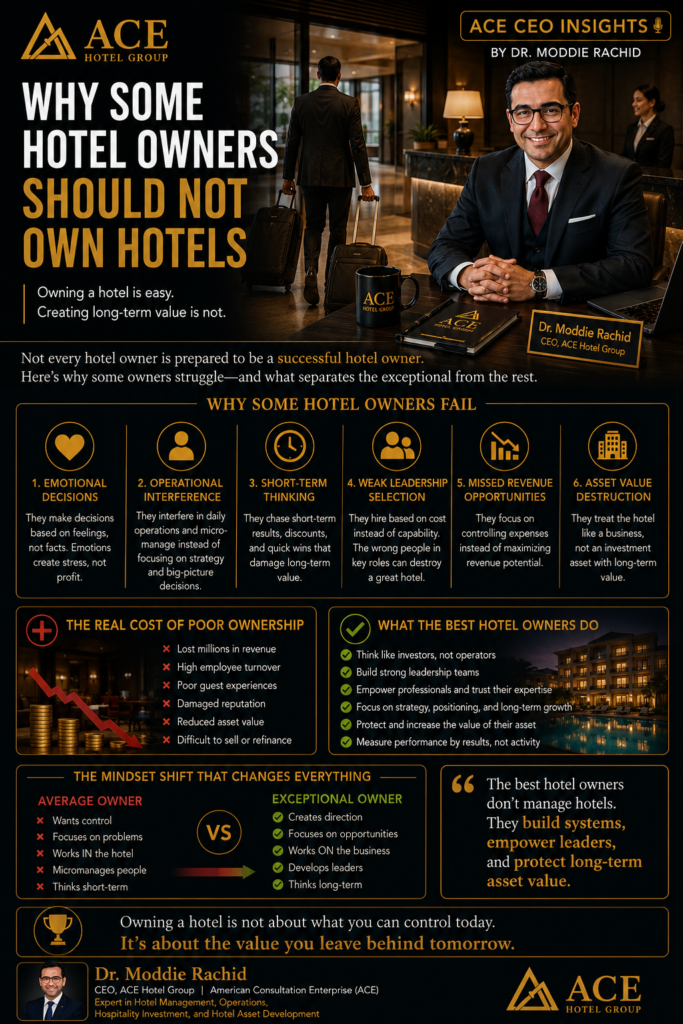
A weak owner asks:”Are we going to hit budget this year?”A sophisticated owner asks:”Are we building an asset that will be more valuable three, five, and ten years from now?”That requires a different mindset.It requires understanding:- Where the market is going- Who the future customer will be- Whether the hotel’s positioning remains relevant- Whether the brand is strengthening or weakening- Whether pricing power is improving- Whether costs are structurally controlled- Whether the physical asset remains competitive- Whether the management agreement supports ownership objectives- Whether today’s capital investment improves tomorrow’s returnsThis is hotel asset thinking.
Some Owners Should Not Be Operators
There is nothing wrong with admitting that.In fact, it can be a sign of sophisticated ownership.A successful owner does not need to personally run the front desk, manage the restaurant, schedule housekeeping, or conduct the daily revenue meeting.The owner needs to know who is doing those things, why they are doing them, how they are being measured, and whether their decisions are creating value.The best owners know when to delegate.But they never delegate accountability.That distinction is fundamental.
The Best Hotel Owners Are Not Micromanagers
They are strategists.They do not interfere with every operational decision.They build the right structure.They hire the right leadership.They establish measurable objectives.They monitor performance.They challenge assumptions.They protect capital.They understand the competitive set.They demand transparency.And they make decisions based on long-term value rather than short-term emotional reactions.The owner should not be the hotel’s second General Manager.The owner should be the guardian of the investment.
The Ultimate Test of Hotel Ownership
If you want to know whether someone truly understands hotel ownership, do not ask:
How many hotels do you own?
Ask:
How much value have you created?”
Ask:
What was the acquisition basis?
What was the original investment thesis?
What has changed?
Has NOI improved?
Has the hotel’s market position strengthened?
Has the physical asset improved?
Has the hotel’s pricing power increased?
Has the return on invested capital improved?
How much capital has been invested?
What is the current valuation?
What would the asset be worth to the next owner?
Those questions reveal the difference between ownership and stewardship.
My CEO Perspective
After years in hospitality, I believe one of the industry’s biggest misconceptions is that owning a hotel is primarily a real estate decision.It is not.It is a business decision, an operating decision, a capital-allocation decision, and a long-term investment decision—simultaneously.The building may be the collateral.The hotel operation creates the cash flow.But the owner’s strategy determines whether those two components create lasting value together.That is why some people should not own hotels.Not because they lack money.Not because they lack intelligence.And certainly not because they cannot buy one.They should not own hotels because they have not yet developed the discipline required to protect, operate, reposition, and grow the value of a hospitality asset.Buying the hotel is easy compared with building its value.—
The Bottom Line
Owning a hotel is a financial transaction.Building a valuable hotel asset is a leadership discipline.The difference is not measured by the number of rooms you own.It is measured by the quality of decisions you make after the acquisition.
The smartest hotel owners do not ask only:”How much money is the hotel making?”They ask:”What is this hotel becoming?”Because ultimately, the greatest hotel owners are not simply owners of buildings.They are builders of assets.—
ACE CEO Insight
If your only objective is to own a hotel, you can buy one.If your objective is to build a valuable hotel asset, you need a completely different mindset.Own the asset. Understand the operation. Challenge the strategy. Protect the capital. Build the value.
contect with Dr moddie rachid;
https://www.linkedin.com/in/dr-mohamedrachid
read more articles;
https://acegroupusa.com/ceo-insights/